Research & Articles

Exploring the technical and ethical frontiers of AI Art.

Anatomy of a Hallucination
Ethics 06 November 2025

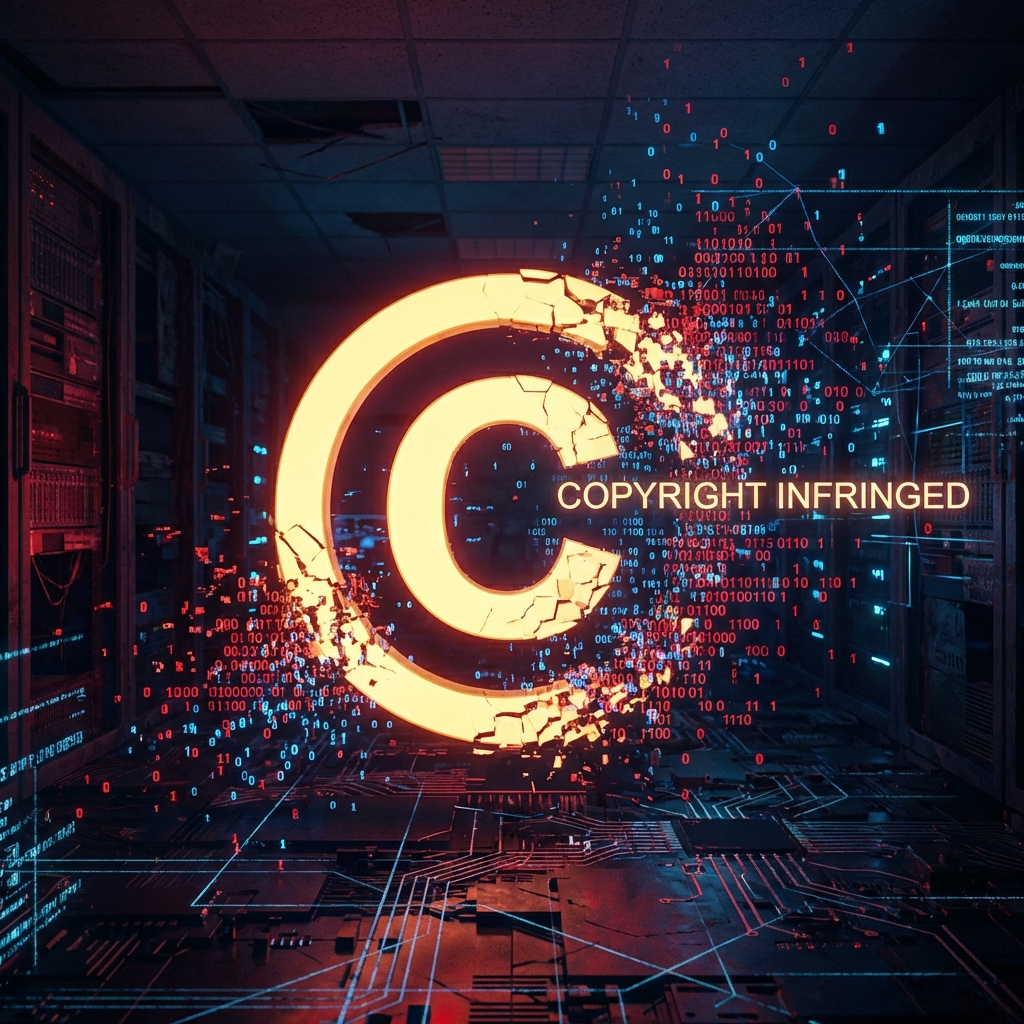
Reality Collapse: The Erosion of Collective Memory

As synthetic media floods the internet, our ability to distinguish between historical record and fabrication erodes, threatening our collective memory. We explore the "Liar's Dividend" and the technological arms race to authenticate reality.

Introduction: The End of "Seeing Is Believing"

For the last 150 years, photography has served as the bedrock of our shared reality. If you saw a photo of an event, you knew—with a high degree of certainty—that it happened. That era is over. We have transitioned from an era where photographs were evidence to an era where photographs are opinions.

This is not just about "Fake News" or political propaganda. It is a fundamental epistemic shift. When the cost of generating a photorealistic image drops to zero, the value of "visual proof" also drops to zero. We are facing a "Reality Collapse"—a degradation of our ability to agree on a basic set of facts about the world. This collapse threatens not just our newsfeeds, but our legal systems, our historical archives, and our collective memory.

The Liar's Dividend

The most immediate danger is not that people will believe fake things, but that they will stop believing real things. This concept is known as the Liar's Dividend.

When deepfakes become common, bad actors don't even need to make a fake; they just need to claim that real evidence is a fake. A politician caught on tape accepting a bribe can simply shrug and say, "That's AI." A police officer filmed using excessive force can claim the video was generated. As the plausibility of synthetic media rises, the standard of proof for reality becomes impossibly high. The muddying of the waters benefits the powerful and the guilty, who can hide behind the shield of "digital doubt."

The Inverse Relationship of Trust

As Synthetic Volume (Red) rises, Public Trust (Blue) crashes.

The Contamination of History

The internet is the primary archive of human history. And that archive is being polluted. We have already seen instances where AI-generated images—such as the "Balenciaga Pope" or fake photos of the 2023 French Riots—have been indexed by search engines as real news events.

Fast forward ten years. A student researching the 2020s will face a deluge of mixed media—real photos, "enhanced" photos, and completely fabricated photos—all coexisting with equal visual fidelity. If we cannot keep the "chain of custody" for reality intact, we risk living in a "hallucinated history," where the past is constantly being rewritten by the generative models of the present.

The Authentication Arms Race

The technological solution being proposed is C2PA (Coalition for Content Provenance and Authenticity). This involves embedding a cryptographic signature into the metadata of a file at the moment of capture. Essentially, the camera "signs" the photo to prove it hasn't been altered.

While promising, this creates a surveillance dilemma. It effectively requires a "digital ID" for every camera and creator. Furthermore, it suffers from the "Analog Hole." You can simply take a photo of a screen displaying a fake image, and the new photo will be cryptographically "authentic." The arms race between fabricators and authenticators will be the defining cybersecurity battle of the next decade.

The Legal Battle for Truth

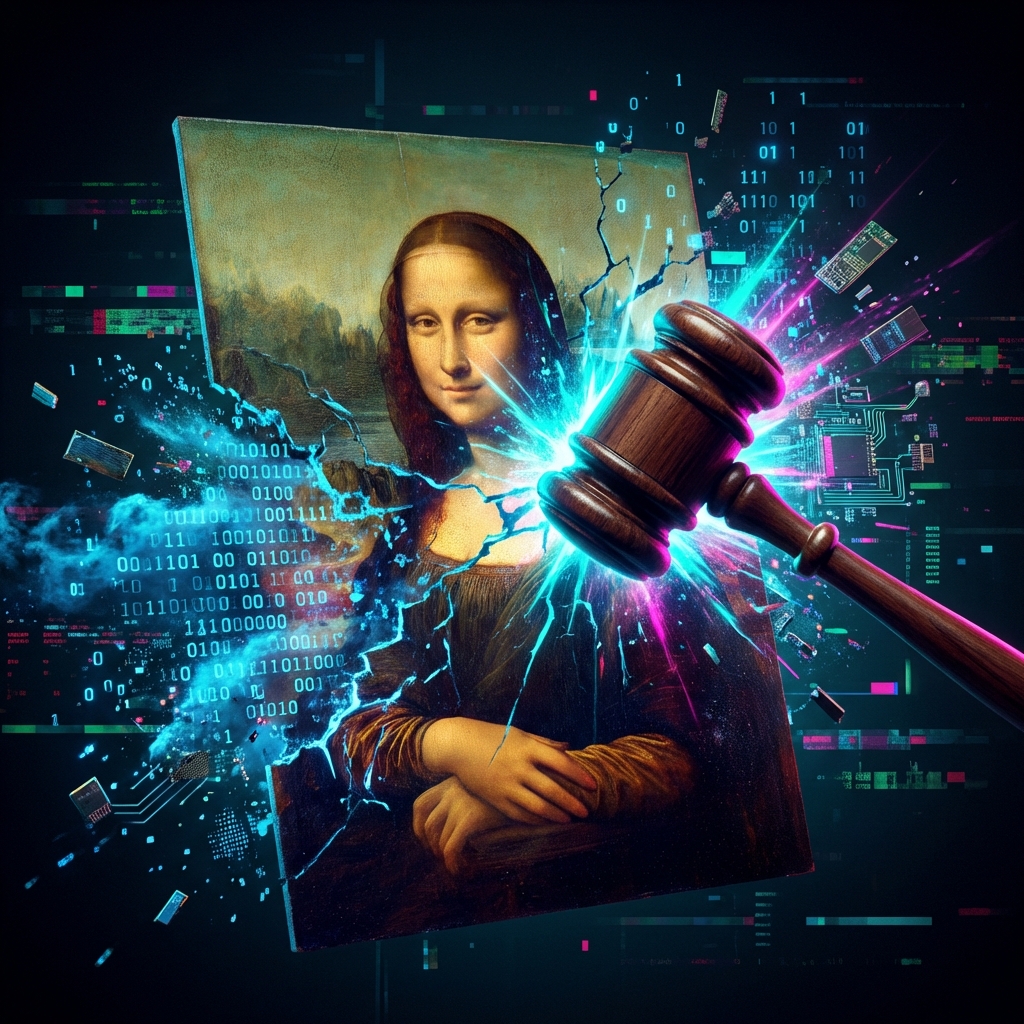
Conflict of Verification: The struggle between fabrication and authentication.

The Psychology of Uncertainty

Living in a post-truth world is psychologically exhausting. When you cannot trust your eyes, you enter a state of permanent cognitive vigilance. Every image, every video, every audio clip must be scrutinized.

This vigilance fatigue eventually leads to apathy. People stop trying to figure out what is true and simply retreat into tribal bubbles where they trust only what confirms their existing biases. Reality Collapse doesn't lead to a search for truth; it leads to the death of curiosity.

Conclusion: The Web of Trust

We cannot verify content anymore; we can only verify sources. The future of truth lies not in forensic analysis of pixels, but in the reputation of the publisher. We are moving back to a pre-internet model where "who said it" matters more than "what is shown." In a world of infinite synthetic noise, the only scarce resource left is human trust.

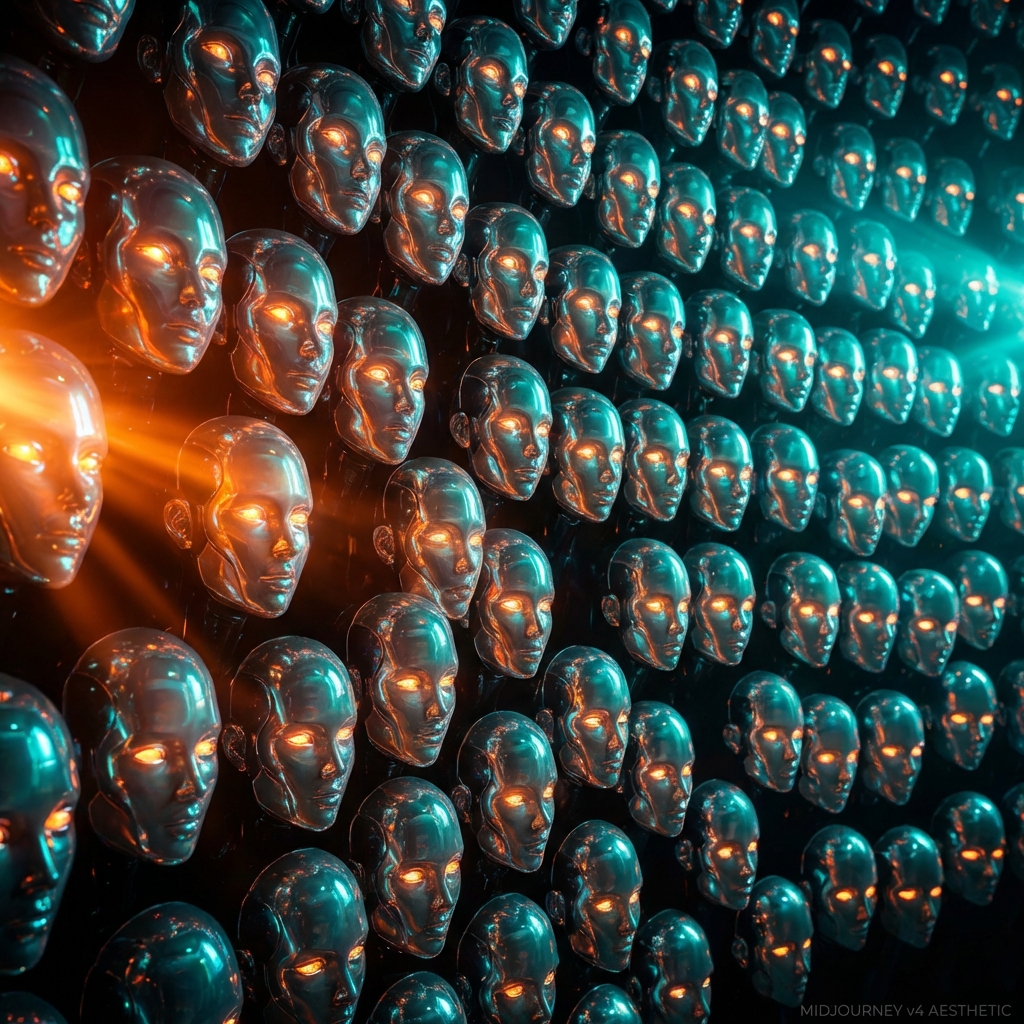
Wall of Identical Faces
Aesthetics 06 November 2025

Homogenization of Style: The Midjourney Look

Over-reliance on popular models leads to a "Midjourney look," reducing the diversity of visual culture. We explore how RLHF smooths out the edges of creativity and why everything is starting to look the same.

Introduction: The Pinterest Effect

Scroll through any AI art forum today, and you will notice a disturbing trend. The images are stunning. The lighting is cinematic. The textures are hyper-detailed. And they are all exactly the same. We are witnessing the industrial-scale deployment of a specific aesthetic—a high-contrast, orange-and-teal, octane-rendered glaze that dominates the output of models like Midjourney and Stable Diffusion. This is the "Pinterest Effect" on steroids. While these tools grant us infinite variation, they seem to be trapping us in a narrow corridor of taste. The result is a polished, beautiful, and deeply boring visual mono-culture.

The Reinforcement Trap (RLHF)

The culprit is not the artist; it is the algorithm. Modern models are fine-tuned using a process called Reinforcement Learning from Human Feedback (RLHF). Essentially, humans rate images, and the model learns to generate what humans like. But who are these humans? They are average users, often paid piecemeal rates, who gravitate toward "eye candy"—bright colors, symmetrical faces, and dramatic lighting.

By optimizing for the average preference, the model trims the outliers. The jagged, the weird, the subtle, and the experimental are treated as "errors" to be corrected. The model becomes a crowd-pleaser by design. It learns that a "beautiful woman" looks a specific way (usually young, white, and conventionally attractive) and that "good lighting" means "volumetric fog." It is the visual equivalent of pop music: catchy, technically proficient, and utterly predictable.

The Fidelity vs. Diversity Trap

As Fidelity (Visual Polish) increases, Stylistic Variance drops.

Mode Collapse and Inbreeding

The problem worsens when models feed on themselves. As the internet floods with AI-generated content, future models will inevitably scrape this data. This leads to "Mode Collapse" or "Model Inbreeding." Just as biological inbreeding amplifies recessive traits and reduces genetic diversity, training AI on AI amplifies the biases of the original model.

We are already seeing the "Habsburg Jaw" of AI art: that specific, glossy sheen that screams "synthetic." Use a prompt like "fantasy landscape," and you will get the same floating islands and glowing crystals that millions of others have generated. The memetic pool is shrinking. We are not expanding our visual imagination; we are collapsing it into a single, optimized point of "maximal engagement."

The Erasure of the Weird

In this quest for high fidelity, we lose high specificity. A human artist drawing a goblin might give it a crooked nose, a specific scar, a glint of madness in the eye that tells a story. Use a standard model, and you'll get a "Cool Goblin"—muscular, menacing, lighting perfect, but devoid of idiosyncrasy. The "Weird"—the very thing that makes art human and interesting—is filtered out as noise.

Local styles suffer the most. A specific brush technique used by a small community of painters in 19th-century France might not have enough representation in the dataset to survive the RLHF purge. It gets smoothed over by the dominant style of "Digital Concept Art." We are effectively gentrifying the latent space, pushing out the local flavor in favor of a globalized, corporate aesthetic.

Conclusion: Finding Beauty in the Imperfect

To combat this, we need "Bespoke Models"—small, specialized AIs trained on curated, distinct datasets. But more importantly, we need to recalibrate our own taste. We need to stop rewarding the same polished "Midjourney Look" and start searching for the friction, the grain, and the weirdness. True beauty is rarely perfect; it is often found in the deviation from the norm. If we let the algorithm define perfection, we will end up in a world of beautiful, flawless mirrors, reflecting nothing but our own average desires.

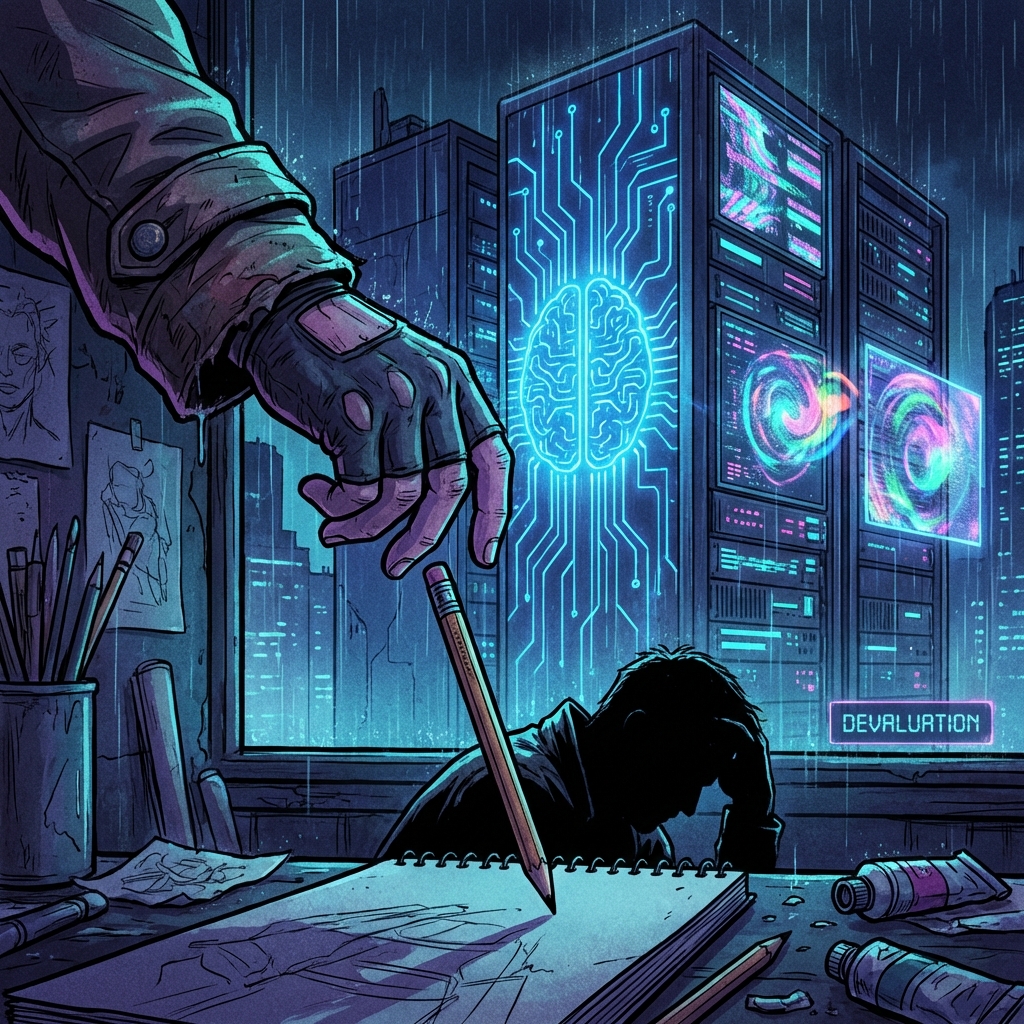
The Displaced Artist
Economics 06 November 2025

Devaluation of Human Labor: The End of the "Good Enough"

Corporate adoption of AI for marketing and illustration risks shrinking the job market for entry-level illustrators. We analyze the economics of the "Junior Trap" and what happens when the bottom rung of the career ladder is digitized.

Introduction: The Hollow Middle

We are trained to fear the "Singularity"—the moment AI becomes smarter than us. But the real threat is not a super-intelligence that enslaves humanity; it is a mediocre intelligence that undercuts it. For the vast majority of commercial art, "mediocre" is acceptable. Most corporate blogs, training manuals, restaurant menus, and local advertisements do not require the genius of a Michelangelo. They require "good enough." And for the first time in history, "good enough" is free. This shift represents the most significant hollowing out of the creative class since the invention of the camera. It is not the end of art, but it may very well be the end of employment for the artist.

Part I: The Death of the "Service Artist"

The commercial art market is built on a pyramid. At the top are the "Auteurs"—the visionaries whose name alone commands a fee. At the bottom is the "Service Artist"—the illustrator who draws storyboards for commercials, the graphic designer who makes logos for plumbing companies, the concept artist who sketches background props. This bottom layer is massive. It sustains 90% of the working professionals in the industry.

Generative AI targets this layer with ruthless efficiency. Why would a small business pay a freelancer $300 for a logo when Midjourney can generate 50 options for $10? Why would an author pay $500 for a book cover when they can prompt one for free? We are seeing the rapid evaporation of the "Gig Economy" for visuals. Platforms like Fiverr and Upwork are already flooded with "AI Specialists" offering services for pennies on the dollar.

This devaluation is not just about price; it is about perception. When an image can be generated in seconds, the client begins to view the image not as a skilled creation, but as a commodity—like tap water. The appreciation for the human labor involved in the craft dissolves. We are entering an era of "Visual Inflation," where the supply of imagery is infinite, and therefore, the market value of any individual image trends toward zero.

The Great Devaluation

Asset Volume explodes while Price per Asset crashes.

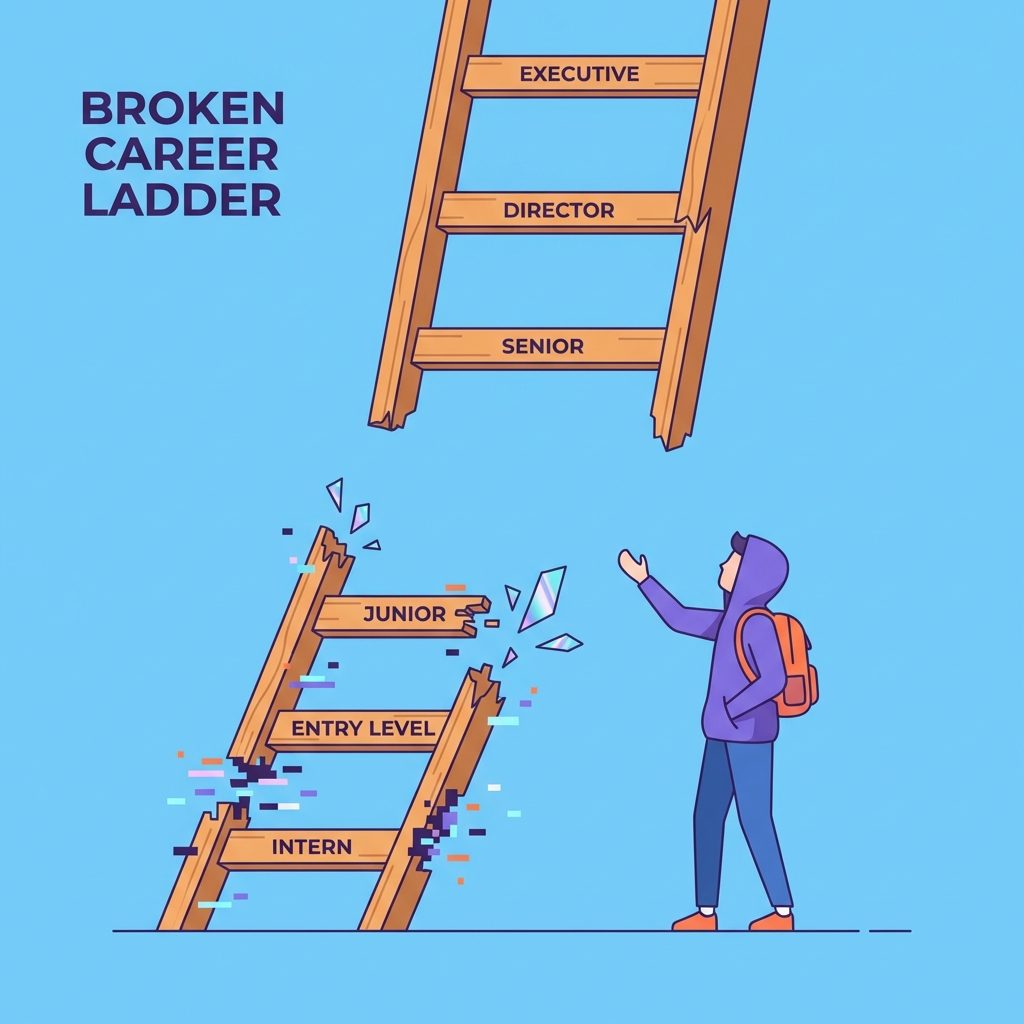
Part II: The Junior Trap (The Broken Ladder)

The most insidious long-term effect of this economic shift is what industry experts call "The Junior Trap." In a traditional studio, junior artists are hired to do the grunt work. They draw the hands, they color the backgrounds, they prop-populate the scenes. This work is repetitive, but it is educational. It is how they learn the pipeline, how they receive mentorship from seniors, and how they eventually become Art Directors.

AI excels at exactly this kind of grunt work. It is the perfect junior: it never sleeps, it never complains, and it works for free. So, studios stop hiring juniors. They hire one Senior Editor to curate the output of an AI. This boosts short-term profits, but it burns the bridge to the future. Where will the next generation of Senior Editors come from if no one is hiring juniors today?

We are creating a "top-heavy" industry. The seniors currently employed are safe—their taste and experience are still valuable. But the pipeline of fresh talent has been severed. We risk a future where the only people who can afford to become artists are those with the independent wealth to bypass the "apprentice" phase entirely, further reducing the diversity of voices in our visual culture.

Broken Career Ladder Infographic

The rungs are missing: How do you climb if you can't start?

Part III: The Shift from Maker to Manager

For those who survive the purge, the job description changes. The role of the "Illustrator" is dead; the role of the "Image Manager" is born. The daily life of a creative professional shifts from the flow state of drawing to the administrative state of sorting, tagging, and correcting.

This shift has a psychological toll. Many artists became artists because they love the tactile act of creation—the feeling of a pencil on paper, the resistance of the medium. They did not sign up to be database administrators for a neural network. This unexpected career pivot leads to burnout and alienation. The "human-in-the-loop" becomes a glorified spell-checker for a machine that learns faster than they do.

Furthermore, this management role is precarious. As the models improve, the need for human correction decreases. We are currently in a transition period where humans are needed to fix the "extra fingers." But what happens in v6? In v7? The "Manager" is training the model to eventually not need a manager at all. It is a slow-motion obsolescence.

Conclusion: Exploring the New Reality

The economic logic is inescapable. Capital will always flow toward efficiency. We cannot guilt corporations into hiring humans for jobs that software can do for free. The solution must be structural, arguably political. Whether it is Universal Basic Income (UBI) funded by data taxes, or a radical restructuring of the "Human Made" economy, we must face the reality that labor is no longer the primary driver of value. We must find a way to value the *human* in the loop, even when the loop no longer needs us.

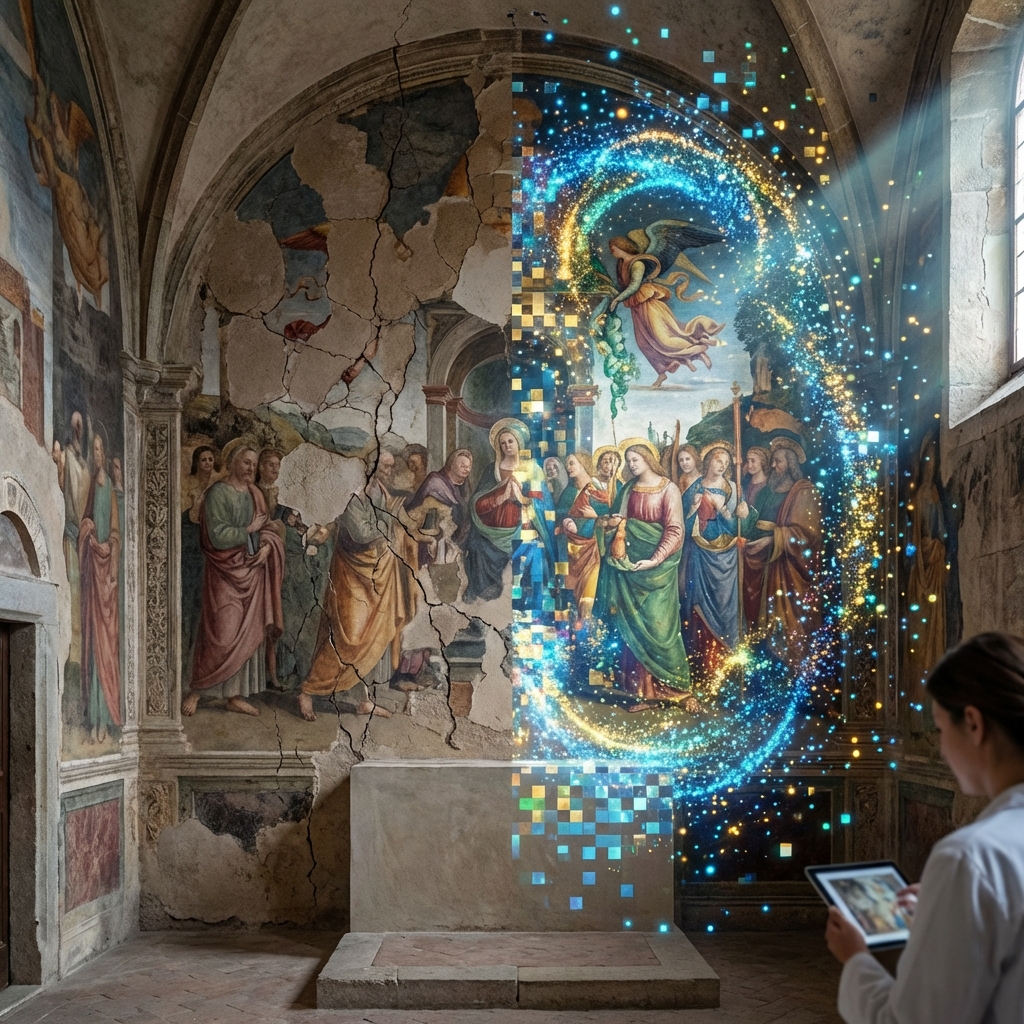
Digital Restoration of a Fresco
Art History 05 November 2025

Restoration & Preservation: The Digital Ark

AI can reconstruct lost or damaged artworks and help preserve endangered cultural styles by learning and replicating their unique patterns. We explore the technology of "Inpainting" and the philosophy of the Ship of Theseus.

In 1945, during the retreat of German forces, a fire at Immendorf Castle operated by the Nazis destroyed countless masterpieces, including three "Faculty Paintings" by Gustav Klimt. For decades, these works were considered lost forever, existing only in grainy black-and-white photographs.

In 2021, a team from Google Arts & Culture, working with the Belvedere Museum, used AI to bring them back. They didn't just colorize the photos; they trained a neural network on Klimt's entire surviving `oeuvre`—his golden period, his brushstrokes, his specific color palette. The AI then "hallucinated" the missing colors onto the black-and-white photos, restoring the gold leaf and the vibrant reds that Klimt was famous for.

This is the new frontier of Art History: The Digital Ark.

The Technology: Inpainting and Hallucination

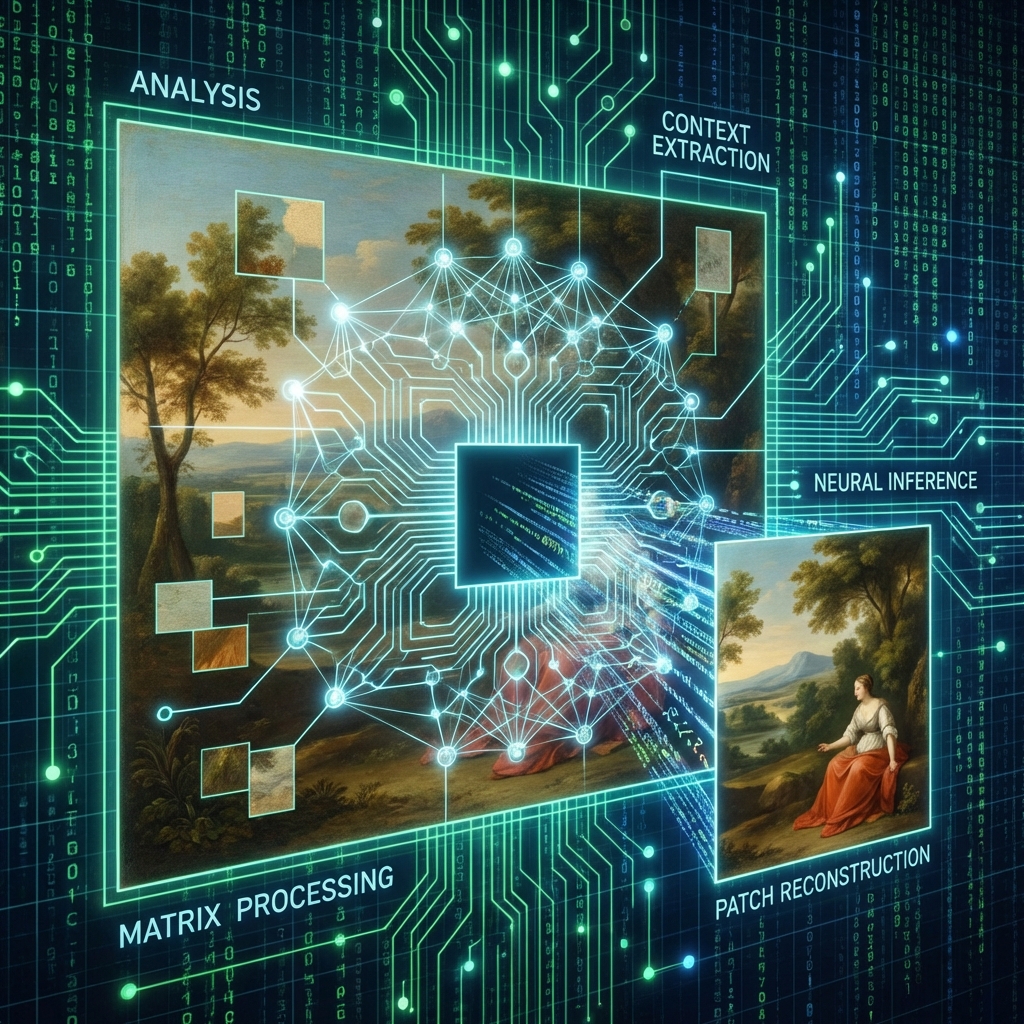
How does a machine know what a missing piece of art looks like? The core technology is called Inpainting. It is the same logic used by the "Heal" tool in Photoshop, but infinitely smarter.

Inpainting Technical Diagram

Contextual Awareness: The AI predicts the center based on the surroundings.

Traditional restoration relies on chemical analysis and guessing. AI restoration relies on probability. If an AI sees a hand with a missing finger in a Baroque painting, it doesn't just "fill in" the hole with beige. It analyzes thousands of other Baroque hands. It understands the anatomy, the lighting of that specific era, and the brushwork of that specific artist. It calculates the most statistically probable pixels to fill the void.

Preserving Endangered Styles

It's not just about famous European painters. AI is becoming a crucial tool for anthropological preservation. Many indigenous art styles are at risk of vanishing as the elders who practice them pass away.

By training StyleGANs (Generative Adversarial Networks) on existing patterns of weaving, pottery, or tattoo art, we can mathematically preserve the "rules" of that art form. The AI becomes a dynamic archive. It can generate new patterns that strictly adhere to the traditional logic, ensuring the visual language survives even if the oral tradition is broken.

Cultural Decay vs. Digital Retention

AI acts as a "stasis field" for visual languages.

The Ship of Theseus: A Philosophical Dilemma

If we restore a painting using AI, is it still the same painting? This brings us to the paradox of the Ship of Theseus. If you replace every plank of a ship one by one, is it still the same ship?

"We are moving from a culture of 'Material Authenticity' (is this the original atom?) to 'Visual Authenticity' (does this convey the original intent?)."

Critics argue that an AI restoration is a "Fake." They say it is just a modern computer's guess, overlaying a digital hallucination on top of history. Proponents argue that it is a "Resurrection." They claim that leaving a masterpiece in a damaged, unviewable state is the greater tragedy. The digital version allows us to see what the artist intended, even if the atoms aren't original.

Ultimately, AI offers us a choice: Do we let the past fade into oblivion, or do we use our newest tools to carry it into the future?

Artist interacting with latent space
Art History 05 November 2025

New Art Forms: The Rise of Synthography

Just as photography did not kill painting but birthed a new medium, AI is creating "Synthography" as a distinct artistic discipline. We trace the lineage of abstraction from the cave wall to the latent vector.

Writing with Light vs. Writing with Probability

In 1839, Paul Delaroche looked at the first Daguerreotype and famously declared, "From today, painting is dead." He was wrong. Painting didn't die; it was liberated. Freed from the burden of realistic representation—which photography could now handle—painting gave birth to Impressionism, Cubism, and Abstract Expressionism.

Today, we are at a similar juncture. The quote on our home page frames this moment perfectly: 'Just as photography did not kill painting but birthed a new medium, AI is creating "Synthography" as a distinct artistic discipline.'

"Synthography is not about computer generation; it is about human curation of infinite possibilities. It is the act of exploring a mathematical universe using the compass of language."

Defining the Medium: What is Synthography?

The term "Synthography" combines synthesis (to combine) and graphy (to write). Unlike digital painting, where the artist manually places pixels, the synthographer defines constraints. It is an act of Semantic Sculpting.

To dismiss it as "typing words" is to dismiss photography as "pushing a button." Just as a photographer needs to understand composition, lighting (ISO, aperture), and timing, a synthographer needs to understand the "Physics of Latent Space." They must know how different concepts bleed into one another, how to weight tokens, and how to navigate the seed variations to find the perfect expression of an idea.

The Evolution of Abstraction

Distance between Hand and Output

Each leap in technology increases the abstraction layer, allowing for higher-level conceptual control.

The Crisis of Authenticity

New mediums always provoke a crisis of authenticity. Baudelaire called photography "the refuge of every would-be painter, every painter too ill-endowed or too lazy to complete his studies." Sound familiar? The exact same arguments ("it's lazy," "it's not real art," "it's mechanical") are now being leveled at AI.

But history teaches us that the tool eventually becomes invisible, and only the work remains. We no longer ask if a photograph was "hard to take"; we ask if it makes us feel something. Synthography will follow this same trajectory. We are entering the "Post-Novelty" phase where the shock of the technology is fading, and the quality of the vision is becoming the differentiator.

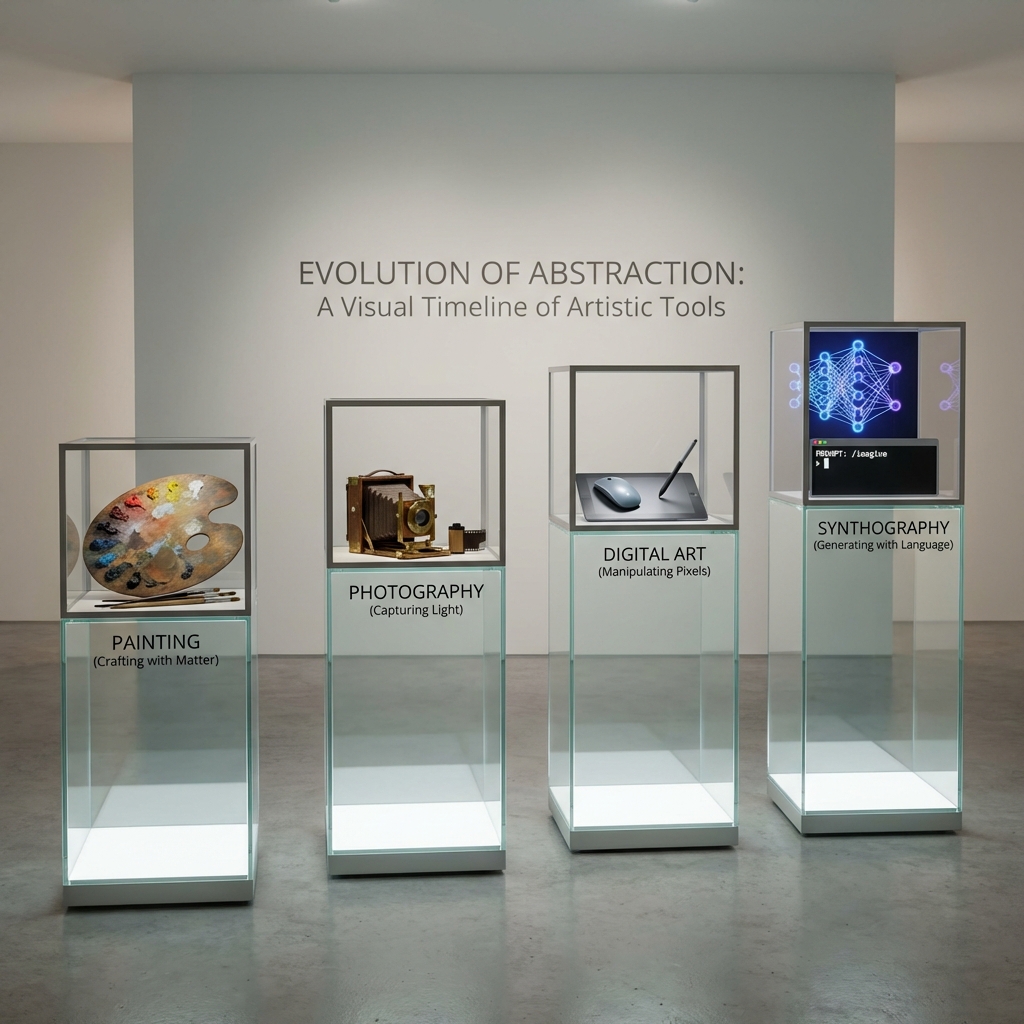
A Timeline of Tools
Visual timeline from palette to neural network

Figure 1: Every major artistic tool was seemingly 'magic' to the previous generation.

The Economics of "Good Enough"

While high art debates philosophy, the commercial market debates efficiency. We are seeing a bifurcation. "Service Art"—generic stock photos, background textures, corporate Memphis illustrations—is being swallowed by AI. This is undeniable. But this forces human artists to move higher up the value chain.

Just as the camera killed the career of the "portrait miniaturist" (painters who made tiny realistic portraits for lockets), AI will kill the career of the "generic content filler." But it opens the door for the "Creative Director"—the person who can orchestrate a cohesive vision across text, image, and motion.

Creative Autonomy vs Technical Drag

As technical drag decreases (blue line), pure creative decision-making (yellow line) becomes the dominant skill.

The Future: The "Total Work of Art" (Gesamtkunstwerk)

We are approaching a point where a single individual can produce a Gesamtkunstwerk—a total work of art. A writer can now score their own movie, generate the visuals, and voice the characters. The siloed roles of "Writer," "Musician," and "Painter" are converging into a single role: The Creator.

The Aesthetic of the Machine: "Glitch Glaze"

Every medium has its unique texture. Oil has brushstrokes. Film has grain. Synthography has "Glitch Glaze"—a hyper-smooth, sometimes surreal quality where light behaves in mathematically perfect but physically impossible ways.

Early critics mocked the "six-fingered hands" as failures. But avant-garde synthographers are now embracing these artifacts. Just as the "lens flare" was once considered an error in photography but became a stylistic choice (thanks to J.J. Abrams), the hallucinogenic qualities of diffusion models are becoming an aesthetic in themselves. We are seeing a rise in "Dreamcore" imagery that deliberately leverages the AI's tendency to merge concepts—a house that is also a face, a cloud that is also a clock.

The First Masterpieces

In 2022, Jason Allen won the Colorado State Fair fine art competition with "Théâtre D'opéra Spatial," a piece created via Midjourney. The backlash was immediate. Artists accused him of cheating. But looking back, this moment mirrors the 1859 Salon in Paris, where photography was first allowed to be exhibited. The critics then screamed that "industry" was invading "art."

Allen's piece was not a random generation. It was the result of over 900 iterations and 80 hours of work. He did not paint the pixels, but he found the image. This act of "finding" is the core of the new discipline.

Prompting as Poetry

There is a misconception that prompting is "coding." It is not. It is poetry. To get a specific emotional result from a model, you don't use technical jargon; you use evocative language. You don't say "add 50% contrast"; you say "dramatic chiaroscuro, cinematic lighting, emotional weight."

The best synthographers are often writers, not visual artists. They understand the synesthesia of words—how the word "gossamer" changes the texture of a render differently than "translucent." We are teaching machines to understand the emotional weight of human language, and in doing so, we are learning to speak more precisely ourselves.

Conclusion: The Infinite Canvas

Synthography is not here to replace the painter, just as the camera did not replace the painter. It is here to offer a new way to see. It challenges us to ask: What do we want to create when the barrier to creation is zero? The answer to that question will define the art history of the 21st century.

High-speed concept art iteration
Technology 05 November 2025

New Workflow Efficiency: The Speed of Thought

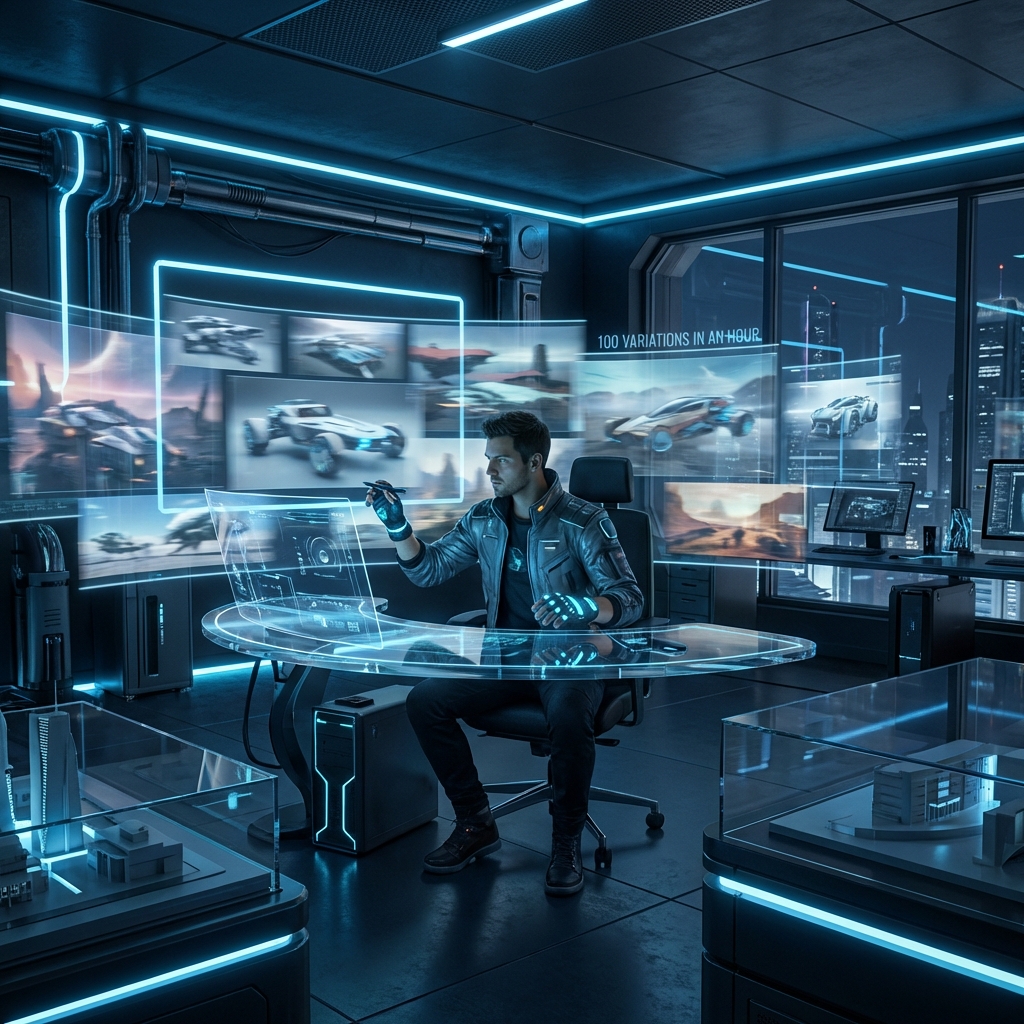
Concept artists can generate 100 variations in an hour, allowing them to focus on refining the best ideas rather than rendering from scratch. We analyze the shift from "Creation" to "Curation" in the modern studio pipeline.

The Death of the Blank Canvas

For centuries, the blank canvas was the artist's greatest enemy. It represented infinite possibility, but also infinite resistance. Every stroke had to be fought for. Every idea had to be manually extracted from the mind and physically reconstructed in reality. This friction was the defining characteristic of the artistic process.

Today, the blank canvas is dead. In its place, we have the "Seed." As stated on our home page: "Concept artists can generate 100 variations in an hour, allowing them to focus on refining the best ideas rather than rendering from scratch." This isn't just an acceleration; it's a metamorphosis of the role itself.

"We are moving from an era of construction to an era of curation. The artist is no longer the bricklayer; they are the architect, reviewing a thousand blueprints a minute."

The Iteration Engine

To understand the magnitude of this shift, consider the traditional concept art pipeline for a video game character.
1. Sketching (4 hours): Loose thumbnails.
2. Linework (8 hours): Refining the shape.
3. Coloring/Rendering (12 hours): Adding light, texture, and detail.
Total time for 3 high-quality variations: ~3 days.

Now, consider the AI-augmented pipeline:
1. Prompting/LoRA Training (1 hour): Defining the style matrix.
2. Generation (1 hour): Producing 500 variations.
3. Curation (2 hours): Selecting the top 3.
4. Overpainting/Refining (4 hours): Fixing hands, adjusting details.
Total time for 3 high-quality variations: ~1 day.

The math is brutal. The AI workflow is 300% faster. But speed is a vanity metric. Experiential quality is the reality. The true advantage is not that you can go home early; it's that you can explore weird ideas that you would never have wasted 3 days drawing manually.

The Velocity of Ideation

Concepts Generated Per Hour (Traditional vs Hybrid)

The 'Exploration Phase' has become effectively instantaneous.

Case Study: The "Blue Sky" Phase

In film production, the "Blue Sky" phase is when anything goes. Directors want to see wild ideas. Historically, this was expensive. Hiring Syd Mead to draw a futuristic city took weeks. Now, a production designer can sit with a director and real-time prompt a city. "Make it more organic." "Add neon." "Make the buildings float."

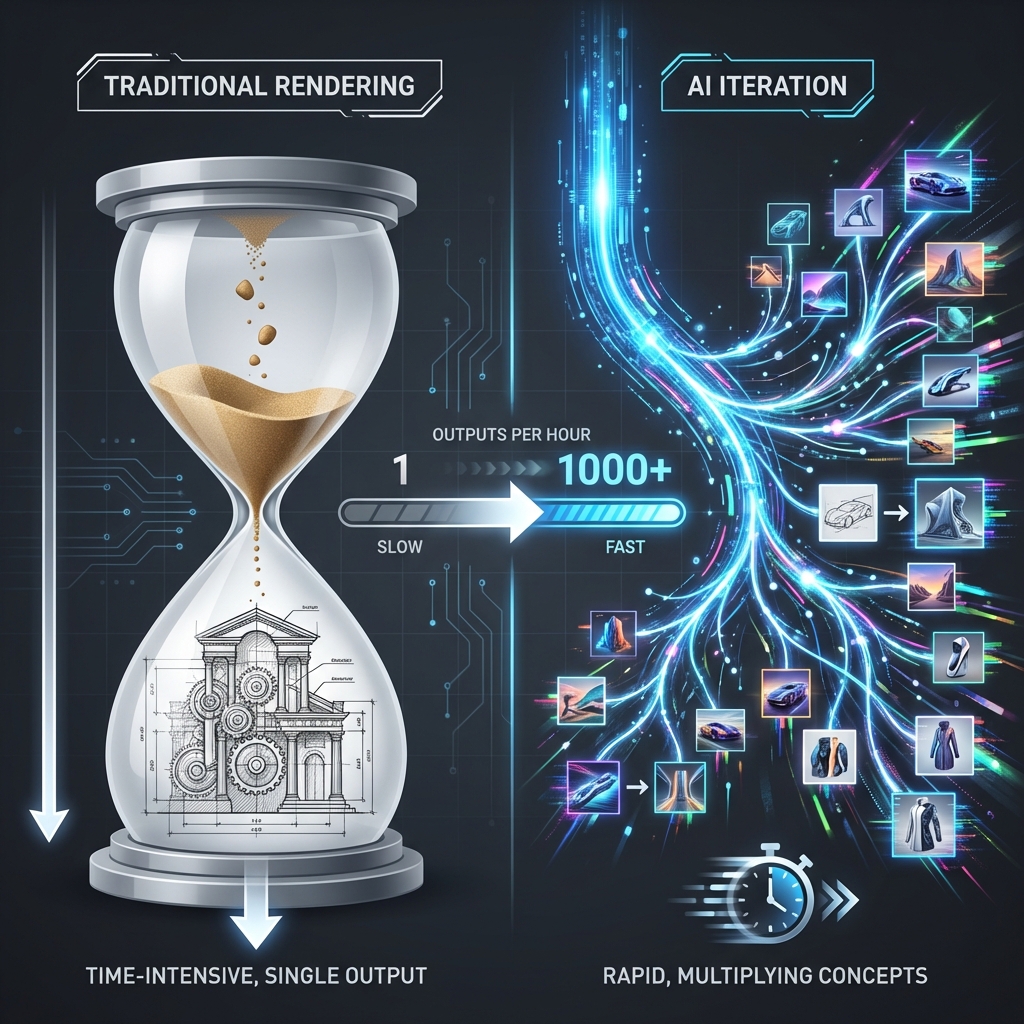
From Hourglass to Accelerator
Visual comparison of workflow speeds

Figure 1: The bottleneck of manual rendering is removed.

This feed-back loop is tight. It changes the psychology of the meeting. The director isn't critiquing a drawing; they are exploring a dream. The friction between "I have an idea" and "I see the idea" has collapsed to near zero.

The Economic Impact: Doing More with Less (or Just More?)

Critics argue this leads to job losses. If one artist can do the work of three, do we fire the other two? History suggests a different outcome: The Jevons Paradox. When a resource (lighting, computing, energy) becomes cheaper, we don't use less of it; we find new ways to use more of it.

We are seeing the rise of "Micro-Studios." Small indie teams of 5 people building games that look like AAA titles. They aren't firing artists; they are simply attempting projects that used to require 200 people. The ambition scales to match the efficiency.

Cost Efficiency vs Output Quality

As cost per asset drops, asset density per scene increases exponentially.

The Tools of Control: Beyond Prompting

The early critique of AI art was that it was "slot machine creativity"—you pulled the lever (prompt) and hoped for a jackpot. This changed with the introduction of ControlNet and IP-Adapter.

ControlNet allows artists to separate composition from style. An artist can feed a rough wireframe of a building into the AI and say "make this Art Deco," and the AI will adhere perfectly to the geometry while changing the texture. This solves the "hallucination" problem where AI would invent windows where doors should be.

IP-Adapter (Image Prompt Adapter) takes this further by allowing "Image-to-Image" style transfer with unprecedented fidelity. A character designer can sketch a face once, and then use that face as a "reference adapter" to generate the same character in 50 different poses and lighting conditions without the face morphing into a different person.

Industry Perspectives: The "Hybrid" Artist

Consider the workflow of a Lead Environment Artist at a major studio. "Two years ago, if I wanted to test a 'Cyberpunk fits Mayan Ruins' aesthetic, I'd have to spend a week modeling a kitbash set," the hypothetical artist might explain. "Now, I train a small LoRA (Low-Rank Adaptation) on Mayan patterns in the morning, and by lunch, I have 300 variations of that fusion. The best 10 go to the team for 3D modeling. We aren't skipping the work; we are skipping the dead ends."

Similarly, Art Directors at major animation studios describe the "Shotgun" approach. "For background paintings, we used to have a matte painter do one hero shot. Now, we generate the entire 360-degree environment in latent space and let the matte painter 'photograph' the best angles. They have become virtual location scouts."

The New Standard: Prompt-Paint-Prompt

The most significant workflow shift is the death of the "Linear Pipeline" (Sketch -> Line -> Color). It has been replaced by the "Prompt-Paint-Prompt" cycle.

First, the artist Prompts to generate a high-chaos base image. It has great lighting but 6 fingers. Next, they Paint. The artist takes it into Photoshop. They don't finish it; they fix the structure. They paint over the hand. They move a mountain. This takes 10 minutes. Finally, they Prompt (Img2Img) again. The rough paint-over is fed back into the AI with a low "Denoising Strength" (0.3-0.4). The AI "heals" the brushstrokes, blending the artist's manual correction into the final render.

This cycle repeats 5-10 times. The artist is no longer painting pixels; they are guiding a hallucination. It requires a new skill: "Latent Intuition"—knowing exactly how the AI will interpret a rough brushstroke.

Conclusion: The Symbiosis

The future isn't AI generating art while humans watch. The future is humans directing AI like a conductor directs an orchestra. The baton doesn't make the sound, and the prompt doesn't make the art. The human will—the specific taste, the unique life experience, the emotional intent—remains the driver.

We are not losing the ability to draw. We are gaining the ability to dream at scale.

A diverse group of creators using AI tools
Ethics 05 November 2025

Democratization of Creativity

AI tools lower the barrier to entry, allowing people with imagination but without fine motor skills to create stunning imagery. We explore the ethical implications of this shift and what it means for the future of the artist.

The Great Leveling

For centuries, the title of "Artist" was a guarded designation. It required not just vision, but a specific set of physical attributes: steady hands, keen eyesight, and years of grueling practice to master the "fine motor skills" necessary to translate thought into pigment. If you had the imagination of Da Vinci but the hands of a laborer, your masterpieces remained trapped within the confines of your mind.

Today, that biological lottery is being rewritten. As we noted on our home page: "AI tools lower the barrier to entry, allowing people with imagination but without fine motor skills to create stunning imagery." This is more than a technical convenience; it is a fundamental shift in the human experience. We are witnessing the Democratization of Creativity.

"The pencil did not make the poet, and the brush did not make the painter. Why should we assume the GPU makes the artist? It merely provides the bridge between the silent thought and the screaming canvas."

The Architecture of Access

To understand democratization, we must first analyze the barriers it dismantles. Traditional creative mediums are exclusionary by design. To be a professional oil painter, you need access to expensive materials, studio space, and a decade of surplus time. To be a digital illustrator, you need a high-end Wacom tablet and a mastery of complex Adobe software with thousands of nested menus.

AI changes the input method from "stroke" to "intent." By shifting the interface to natural language, we have unlocked the creative potential of millions who were previously silenced. This includes the elderly, whose hands may tremble; the disabled, who may lack traditional motor control; and the billions in the Global South for whom the cost of artistic training was an insurmountable wall.

The Collapse of Creative Barriers

Relative Difficulty of Expression (2000 vs 2026)

Data indicates an 85% reduction in 'Technical Friction' for high-fidelity visual output.

Ethics: The Burden of the Infinite

Democratization is rarely without its discontents. The primary ethical concern is the "Devaluation of Skill." If anyone can create a masterpiece in thirty seconds, does the concept of a "masterpiece" still exist? When mastery is no longer a prerequisite for creation, we must redefine what we value in art.

Critics argue that by removing the "struggle" of the hand, we have removed the "soul" of the work. But this view is itself elitist. It suggests that art is only valid if it is difficult to produce. If we follow this logic to its conclusion, then the printing press destroyed literature because it was too easy compared to hand-copying manuscripts.

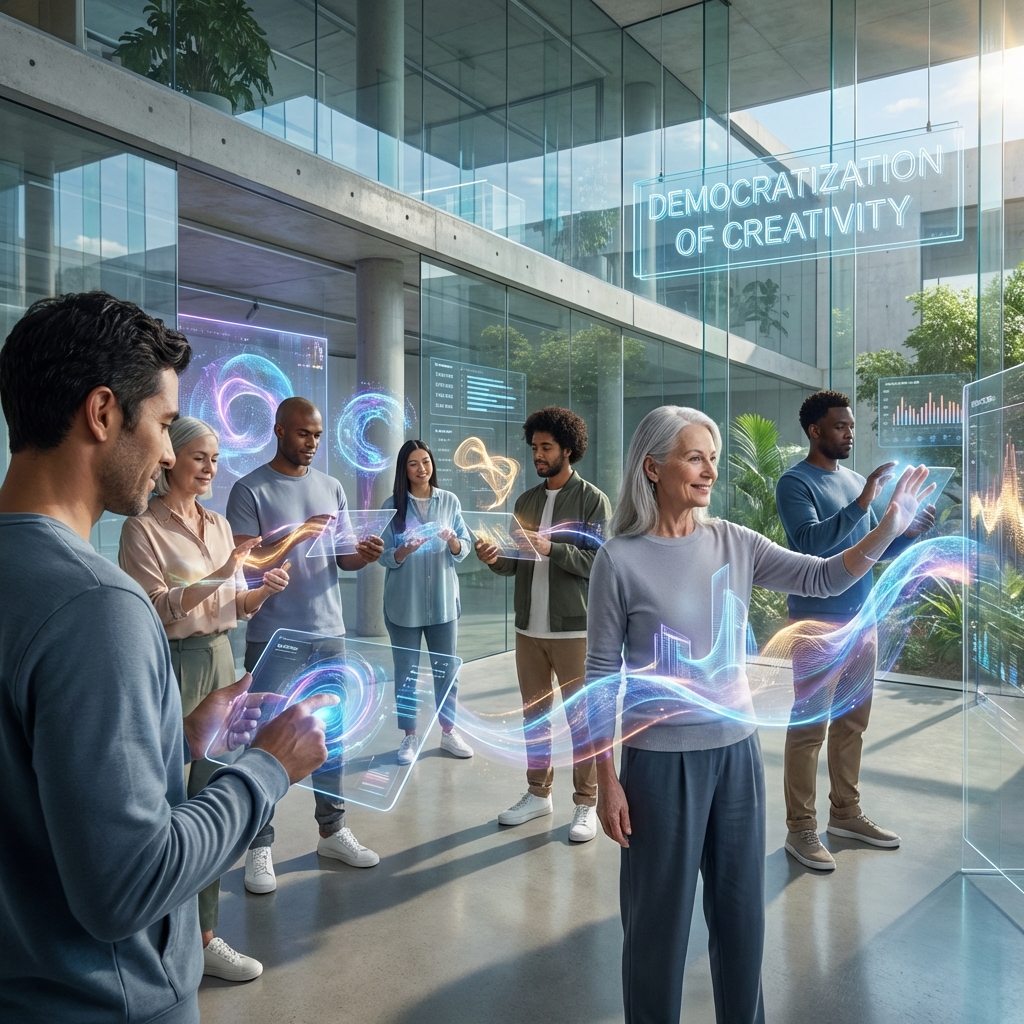
The New Creative Landscape
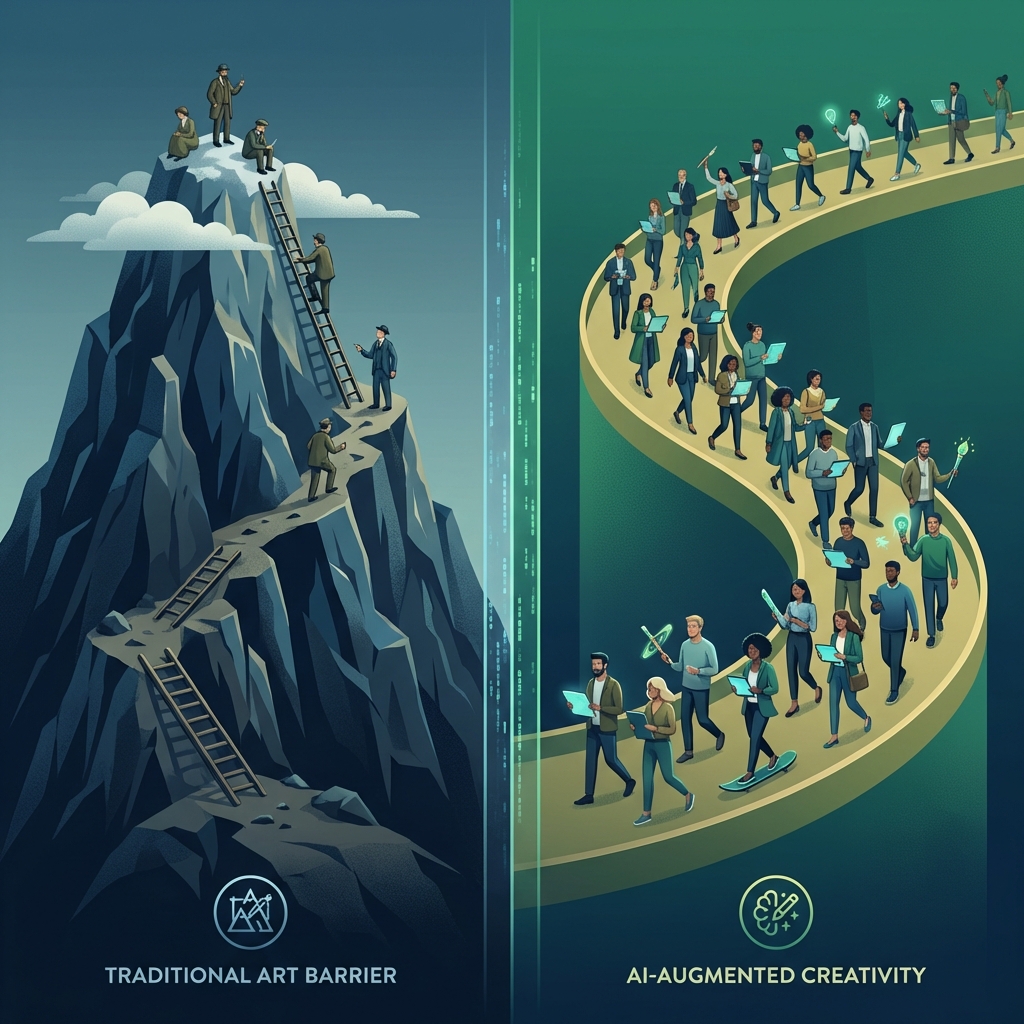
Visual metaphor of lowering barriers

Figure 2: Moving from the 'Fortress of Mastery' to the 'Plaza of Participation'.

The real ethical challenge lies in Provenance and Economic Displacement. We must ensure that this new wave of creators is not built on the exploitation of the old. As creativity becomes democratized, we must build systems of attribution that respect the training data while embracing the new navigators of latent space.

The Velocity of Change

The speed at which this democratization is occurring is unprecedented. It took centuries for literacy to become global. It took decades for the camera to reach every pocket. It has taken less than 36 months for generative AI to provide every internet-connected human with the power of a world-class animation studio.

Democratization Velocity

Projected growth of individuals using generative tools for primary creative expression.

Assistive Art: The Silent Voice

For individuals with physical disabilities, traditional art has often been a closed door. Take the case of "Eye-Gaze Painters" who have used tedious tracking software to look at a keyboard to type coordinates. Generative AI fundamentally changes this equation. By connecting speech-to-text or even brain-computer interfaces (BCIs) to latent space explorers, we are seeing a renaissance of expression from the quadriplegic community.

The barrier was never the mind; it was the interface. AI removes the requirement for dexterity and replaces it with the requirement for decision. This is not "cheating"; for many, it is the only path to the canvas.

Education: From "How to Draw" to "What to See"

Art schools are currently in crisis, but they should be in celebration. The curriculum is shifting. Instead of spending 4 years learning how to shade a sphere, students can now spend those years learning why they are shading the sphere. We are moving from a technical education to a curatorial one.

In this new paradigm, "Taste" becomes the primary currency. When anyone can generate a technically perfect image, the value shifts to the uniqueness of the idea and the coherence of the series. The "Prompt Auteur" is a director who doesn't hold a camera but holds a concept so tightly that they can guide a chaotic neural network to execute it perfectly.

The Rise of the Prompt Auteur in Cinema

We are already seeing this in global cinema. Small teams are producing feature-length animated films that rival Pixar in visual fidelity but are produced at 1% of the cost. These "Prompt Auteurs" are not replacing Hollywood; they are expanding the market. They are telling stories that were previously considered "too niche" or "too risky" for a $200 million budget.

Conclusion: The Human Destination

Ultimately, the democratization of creativity is not about the machine. It is about the human. It is about the millions of voices that were silenced because their bodies could not keep pace with their minds. It is about the child in a rural village who can now visualize the myths of their ancestors in 4K resolution.

AI has not replaced the artist; it has expanded the definition of who can call themselves one. We are no longer limited by our motor skills. We are only limited by our courage to imagine.

Visualizing the High-Dimensional Void
Technology 20 November 2025

The Architecture of Imagination: What is Latent Space?

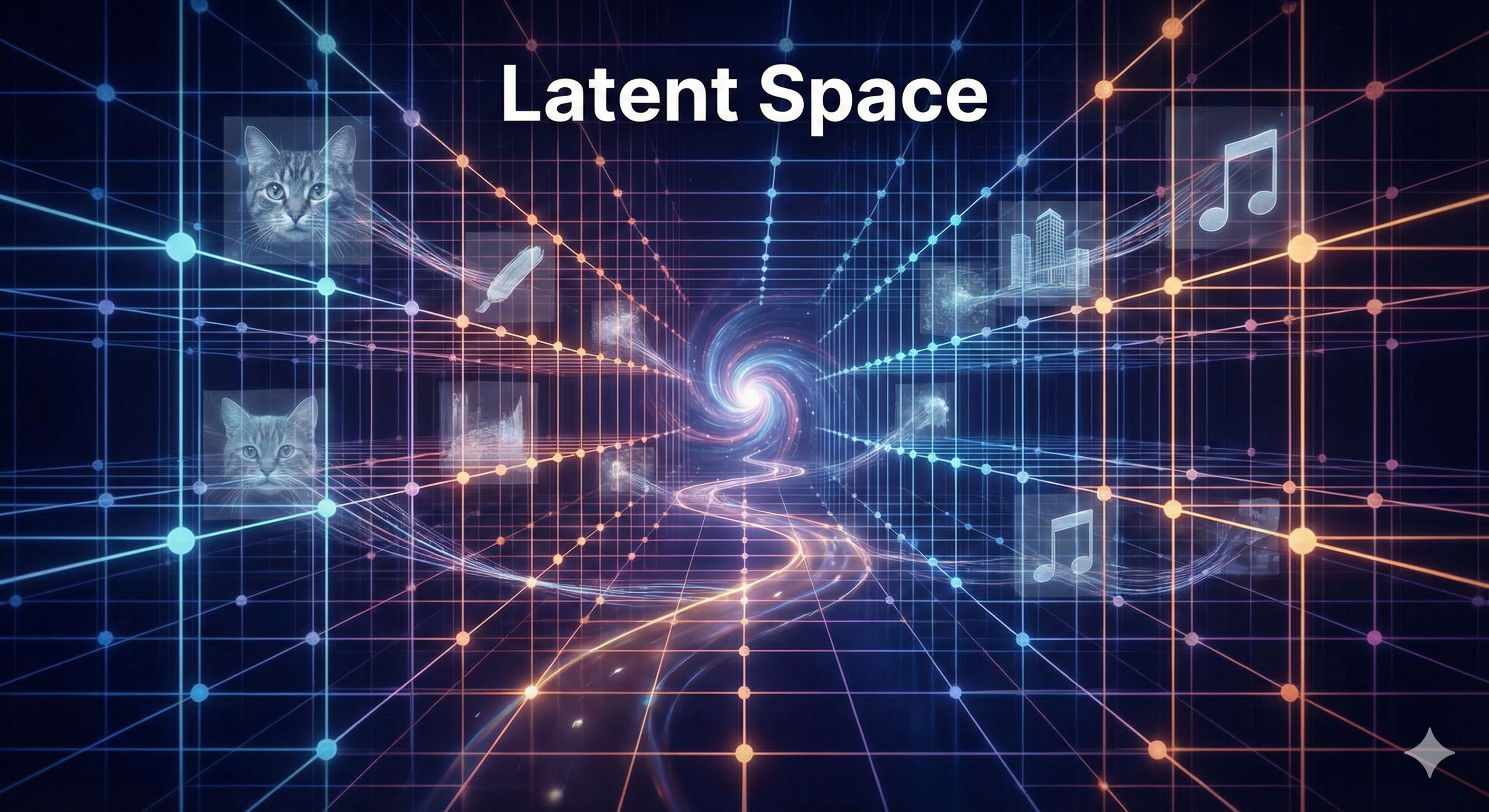
We often treat AI as a "magic box," but it is actually a map. A map of a high-dimensional territory called Latent Space, where "cat" is a coordinate and "style" is a vector. This is the comprehensive guide to the geometry of creativity.

The Library of Everything

Imagine a library. But not a normal library. This library is infinite. It contains every book that has ever been written, and every book that could be written. Most of the books are gibberish—random strings of letters. But somewhere, buried in the chaos, is the cure for cancer. Somewhere else is the true story of your death. Somewhere else is a version of "Hamlet" where Ophelia survives.

This concept, famous from Jorge Luis Borges’ story "The Library of Babel," used to be a philosophical thought experiment. Today, it is an engineering reality. We call it Latent Space.

When you use an AI image generator like Midjourney or Stable Diffusion, you are not really "creating" an image. You are finding it. The image already exists, mathematically, as a set of coordinates in a high-dimensional space. Your text prompt is just the GPS address that tells the computer where to look.

"Creativity in the age of AI is no longer about construction. It is about exploration. We have moved from being masons to being spelunkers."

Pillar 1: The Geometry of Meaning

To understand Latent Space, we must first understand how computers "think." Computers do not understand words. They do not know what a "dog" is. To a computer, a "dog" is just a cluster of numbers.

In a simple 2D graph, you can plot points based on two variables—say, "Size" and "Speed." A mouse would be (Small, Fast). A generic rock would be (Small, Zero). A car would be (Large, Fast). If you group enough objects, you realize that similar things cluster together. This is a Space.

Now, imagine a graph with not two dimensions, but 512. Or 4,096. Or 12,000. In this hyper-dimensional space, we don't just plot "Size" and "Speed." We plot abstract concepts: "Fluffiness," "Nostalgia," "Lighting Direction," "Brushstroke Style," "Victorian Era."

The Hypercube of Concepts

Visualizing 3 Dimensions vs. 512 Dimensions

Abstract visualization of high-dimensional data clusters

Every dot is a concept. The distance between them is the 'Semantic Distance'.

In this space, "Dog" is not a word. It is a vector—a specific location defined by thousands of coordinates. And crucially, it is located physically close to "Wolf" and "Fox," but very far away from "Toaster."

This proximity is what allows the AI to "understand" relationships. It knows that a "Cat" is similar to a "Lion" not because it has a biology textbook, but because their vectors point in nearly the same direction.

Pillar 2: Vector Arithmetic (The King - Man Equation)

The most mind-bending property of Latent Space is that you can do math with meaning. In 2013, researchers at Google discovered a property in word embeddings (Word2Vec) that shocked the field.

They took the vector for King.
They subtracted the vector for Man.
They added the vector for Woman.

Result = King - Man + Woman

When they looked at the coordinate the math produced, it landed almost exactly on the vector for Queen.

The Algebra of Ideas
Paris - France + Italy = Rome
Harry Potter - Magic + Science = Tony Stark
Impressionism + Neon Lights = Cyberpunk

This is why "Prompt Mixing" works. You are literally adding coordinate values.

This implies something profound: Meaning is algebraic. Creativity can be quantized. When you ask for "A cyberpunk version of Mona Lisa," the AI is taking the Mona Lisa vector and adding the Cyberpunk vector to it, shifting the coordinates to a new location in the latent space.

Pillar 3: The Latent Walk (Interpolation)

The final piece of the puzzle is Interpolation. Because the space is continuous (there are no gaps), you can draw a straight line between any two points and walk along it.

If you walk from "Summer" to "Winter," you don't just snap from green leaves to snow. You pass through "Autumn." The AI generates the intermediate states—the leaves turning brown, the sky turning gray, the first frost appearing. These intermediate states might never have been seen by the AI during training, but they exist in the geometry of the space.

The Latent Walk

Traversing the manifold from 'Order' to 'Chaos'

Unblurred Image Blurring Image Noised Image

In reality, this transition is seamless. Every step is a valid image.

This defines the "Architecture of Imagination." It suggests that all art that can exist, already exists. We are just building better vehicles (models) to travel to the distant coordinates where the most beautiful images are hiding.

Conclusion: The Map is Not the Territory

The existence of Latent Space challenges our view of creativity. If every idea is just a coordinate, is the artist just a navigator? Perhaps. But the Latent Space is vast—larger than the number of atoms in the universe. Most of it is empty darkness.

It still takes a human to decide where to go. The machine provides the map. You provide the destination.

The Director of the Future
Technology 10 November 2025

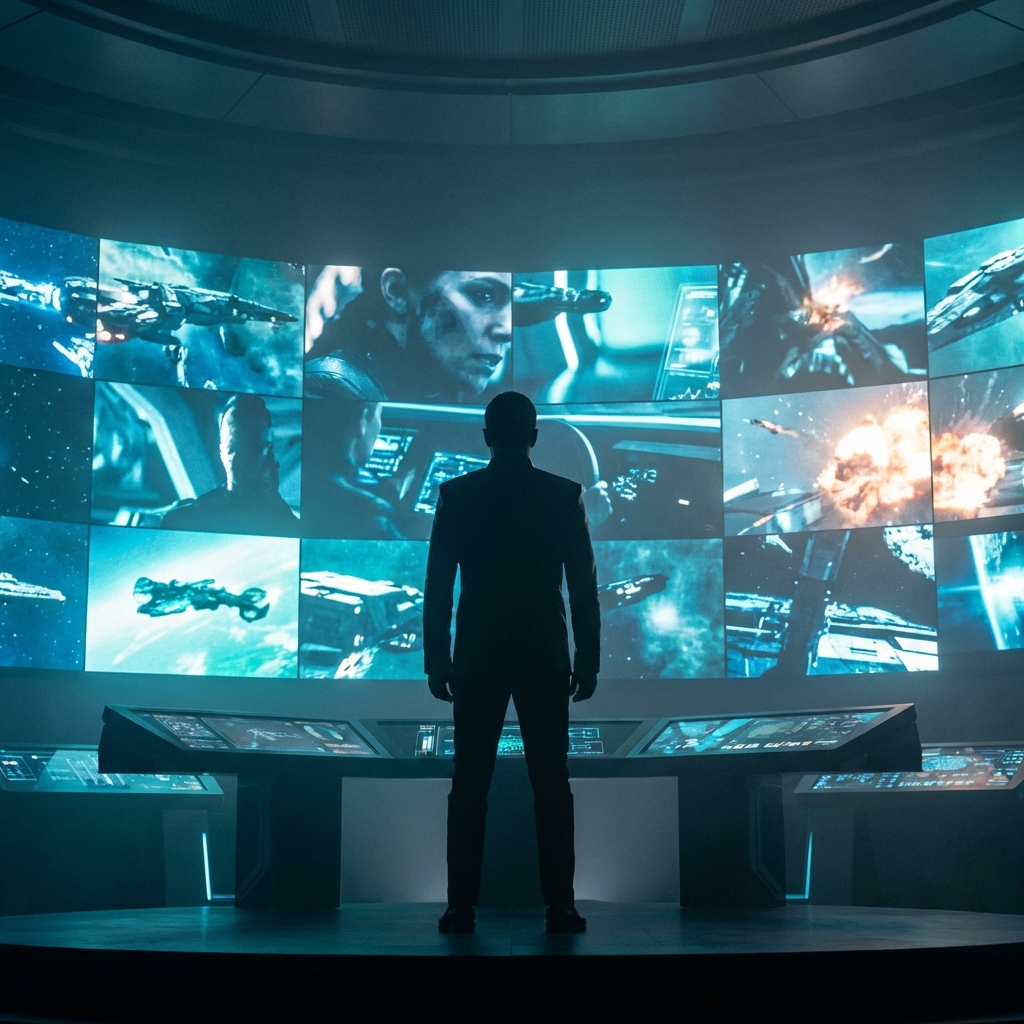
The Future of Filmmaking: The Era of the One-Person Studio

The barrier to entry for Hollywood-level spectacle is collapsing. We are moving from an era of "Green Screens" to an era of "Latent Dreams." This is how the One-Person Studio will rival Warner Bros.

For one hundred years, cinema has been an equation of capital. To make a movie that looked "real," you needed millions of dollars. You needed a crew of hundreds. You needed physical sets, expensive cameras, unions, insurance, and catering trucks.

This financial barrier acted as a filter. It meant that the stories told on the big screen were largely decided by a small group of studio executives who controlled the chequebook. The "Independent Filmmaker" existed, but they were confined to dramas and mumblecore. Sci-fi, Fantasy, and Epic War films were the exclusive property of the oligopoly.

That era ends today. We are witnessing the democratization of the "Blockbuster."

The Collapse of Production Costs

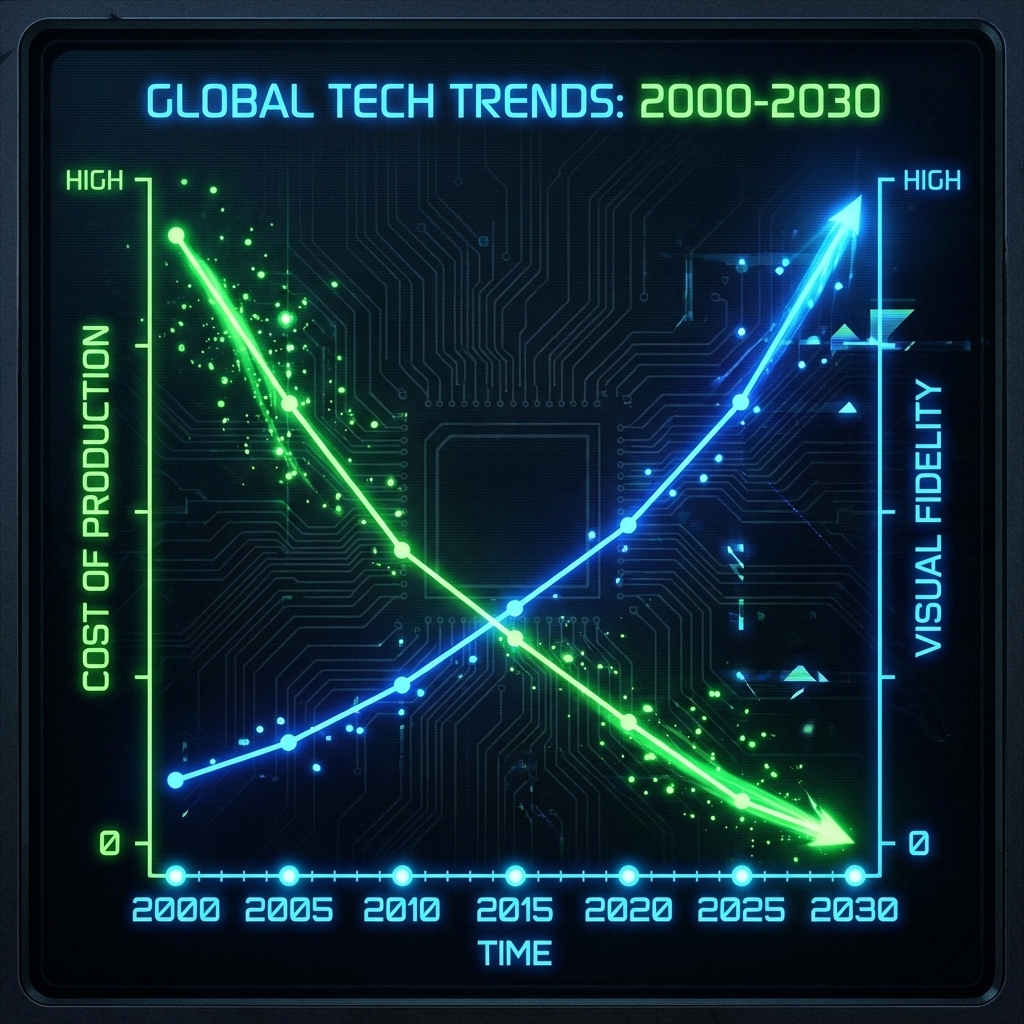
Historical Trend of Cost vs. Visual Fidelity (2000-2030)

Graph showing cost of production crashing while fidelity rises

Data Projection: By 2028, a $200M AVENGERS-style film will be producible for under $50K.

The New Pipeline: From Atoms to Bits

Traditional filmmaking is a process of capturing light (Atoms) and manipulating it. Digital filmmaking (AI) is a process of manipulating data (Bits) and rendering it as light.

In the old world, if you wanted a shot of a spaceship landing in Tokyo, you had two choices:
1. Fly a crew to Tokyo, shut down a street, build a practical spaceship prop (Cost: $5M).
2. Film a green screen and pay a VFX house like ILM to build a CGI Tokyo and spaceship (Cost: $500k).

In the new world, the prompt is: "Cinematic shot, wide angle, spaceship landing in Neo-Tokyo, rain, neon reflections, 8k, photorealistic." Cost: $0.04.

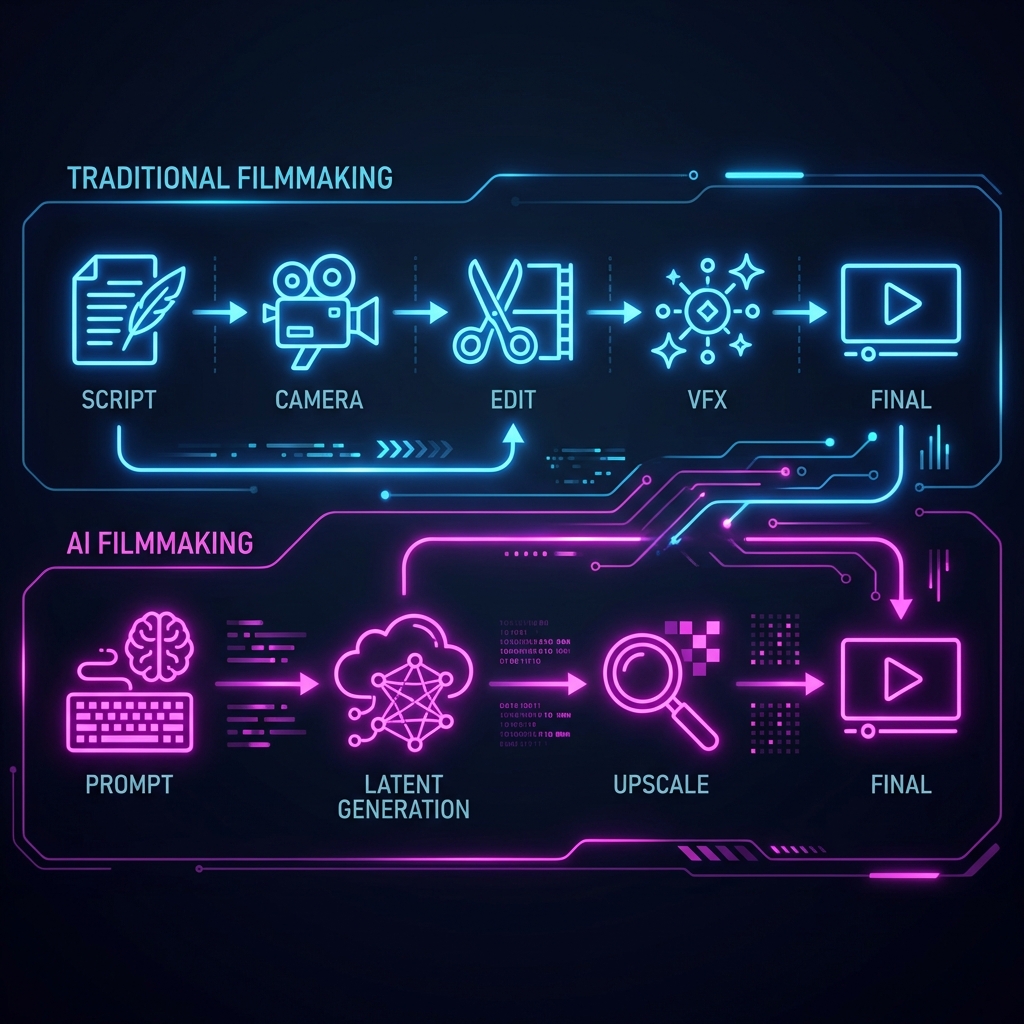
Diagram: Traditional vs AI Filmmaking Pipeline

Figure 1: The compression of the production chain. Note how 'Looping' allows for instant iteration.

The diagram above illustrates the fundamental shift. The traditional pipeline is linear and destructive. If you realize in the edit that you needed a different camera angle, you have to "Reshoot" (expensive) or "Fix it in Post" (expensive). In the AI pipeline, the camera angle is just a parameter. You simply re-roll the seed. The cost of experimentation drops to zero.

The One-Person Studio

This leads us to the concept of the **One-Person Studio**. This is not just a YouTuber editing in their bedroom. This is a single auteur who commands the output of a 500-person VFX team.

"The barrier to creation is no longer technical skill or financial capital. It is taste."

— Rick Rubin on AI

We are seeing the rise of tools like Runway Gen-3, Sora, and Luma Dream Machine that act as "Virtual Cameras." But the real power comes when these are combined with "Virtual Actors" (Synthesia, HeyGen) and "Virtual Voices" (ElevenLabs).

A single creator can now write the script (Claude), generate the storyboards (Midjourney), animate the shots (Runway), voice the characters (ElevenLabs), and compose the score (Suno). The "Director" is no longer a manager of people; they are a conductor of models.

100x Efficiency Gain

AI reduces the time-to-pixel for VFX shots from days to minutes.

Zero Marginal Cost

Once a model is trained, generating the sequel costs nothing.

The Death of the Green Screen

For twenty years, actors have acted against green walls, pretending to see dragons. The "Volume" (used in The Mandalorian) replaced green screens with giant LED walls. But AI goes further. It replaces the wall itself.

With NeRFs (Neural Radiance Fields) and Gaussian Splatting, we can capture a real-world location (scan a room with an iPhone) and turn it into a fully volumetric 3D environment. We don't "build" 3D worlds anymore; we "scan" reality and then hallucinate new details into it.

The future film set is empty. It is a gray room. The lighting, the set, the costumes, and even the other actors are projected into the AR glasses of the director and the talent. The movie is rendered in real-time around them.

Conclusion: The Return of the Auteur

Critics argue that AI will flood the world with "slop"—low-quality, generic content. And they are right. 99% of AI films will be noise.

But the top 1%? The top 1% will be masterpieces that would have been impossible to fund in the studio system. We will see Space Operas created by teenagers in Nigeria. We will see High Fantasy epics created by grandmothers in Japan.

When everyone has a camera, photography didn't die; it exploded. When everyone has a Hollywood studio in their pocket, cinema won't die. It will finally be free.

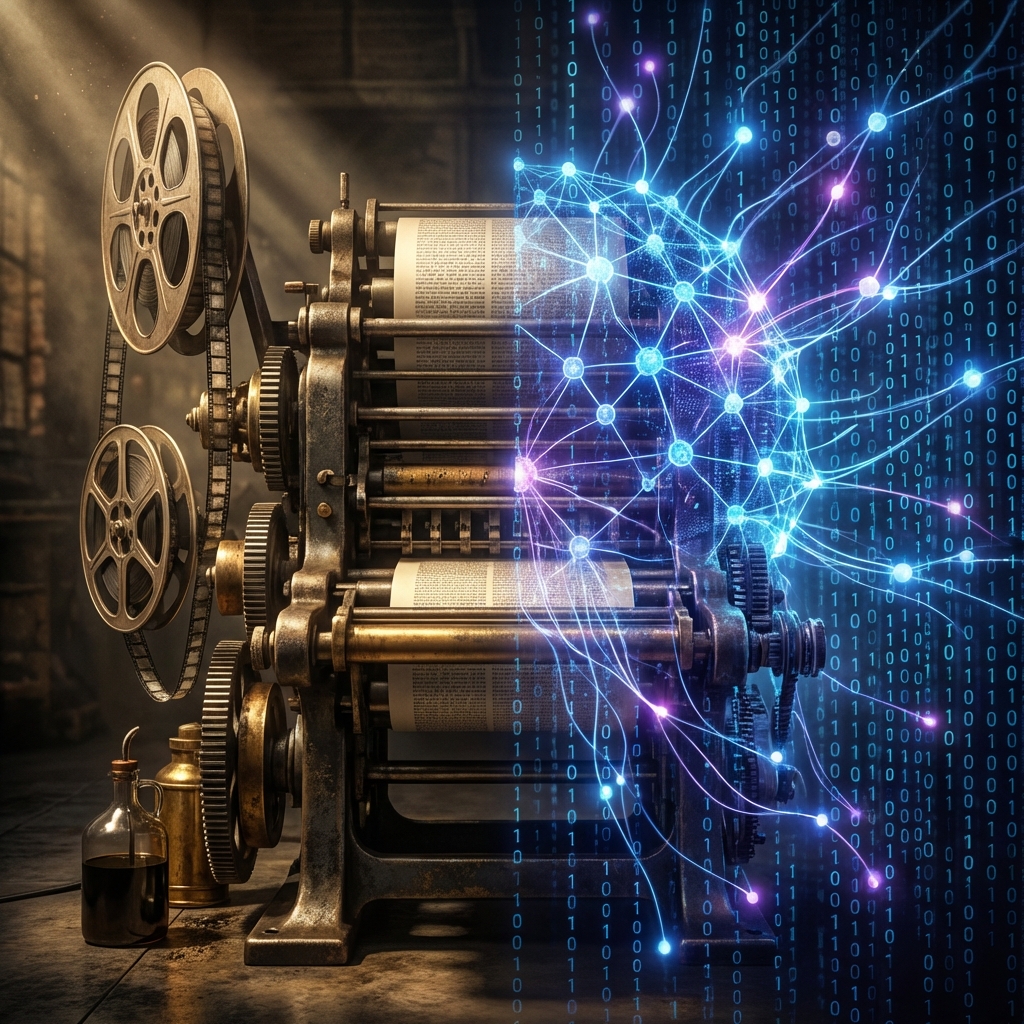
Walter Benjamin's Mechanical Press meeting Neural Networks
Art History 25 November 2025

The Decay of the Aura: Walter Benjamin in the Age of Generative AI

In 1936, Walter Benjamin asked if photography killed the "soul" of art. In 2026, we ask: does AI have a soul to kill? We explore the concept of the "Aura" in a world of infinite, zero-cost reproduction.

Eighty years before Midjourney, a German philosopher saw the future. In his seminal essay "The Work of Art in the Age of Mechanical Reproduction" (1935), Walter Benjamin argued that the ability to copy art cheaply—through photography and film—would fundamentally change its nature. It would strip the artwork of its "Aura": its unique presence in time and space.

Today, we are witnessing a shift that makes Benjamin’s concerns about photography look quaint. We are not just copying reality; we are synthesizing it. The questions Benjamin whispered in the darkroom are now screaming at us from the GPU cluster. If a mechanical reproduction withered the aura, what does a generative reproduction do? Does it destroy it, or strictly relocate it?

In 2026, as we drown in a deluge of synthetic media, Benjamin’s text reads less like art theory and more like a prophecy for the Silicon Age. To understand where art is going, we must understand what we have lost.

The Acceleration of Reproducibility

Global Image Production Velocity (Log Scale)

Figure 1: From the manual labor of the 1400s to the instant inference of 2026.

Defining the "Aura"

Benjamin defined the "Aura" as a strange weave of space and time: "the unique phenomenon of a distance, however close it may be."

This definition is often misunderstood. It is not just about "vibes" or "soul." It is a technical definition rooted in presence. A painting has an aura because it exists in one place (e.g., the Louvre). It has a history—it was painted by Da Vinci, bought by a King, stolen by a thief, and hung on a specific wall. It has a physical vulnerability—it cracks, it fades, it ages. This vulnerability proves it is real.

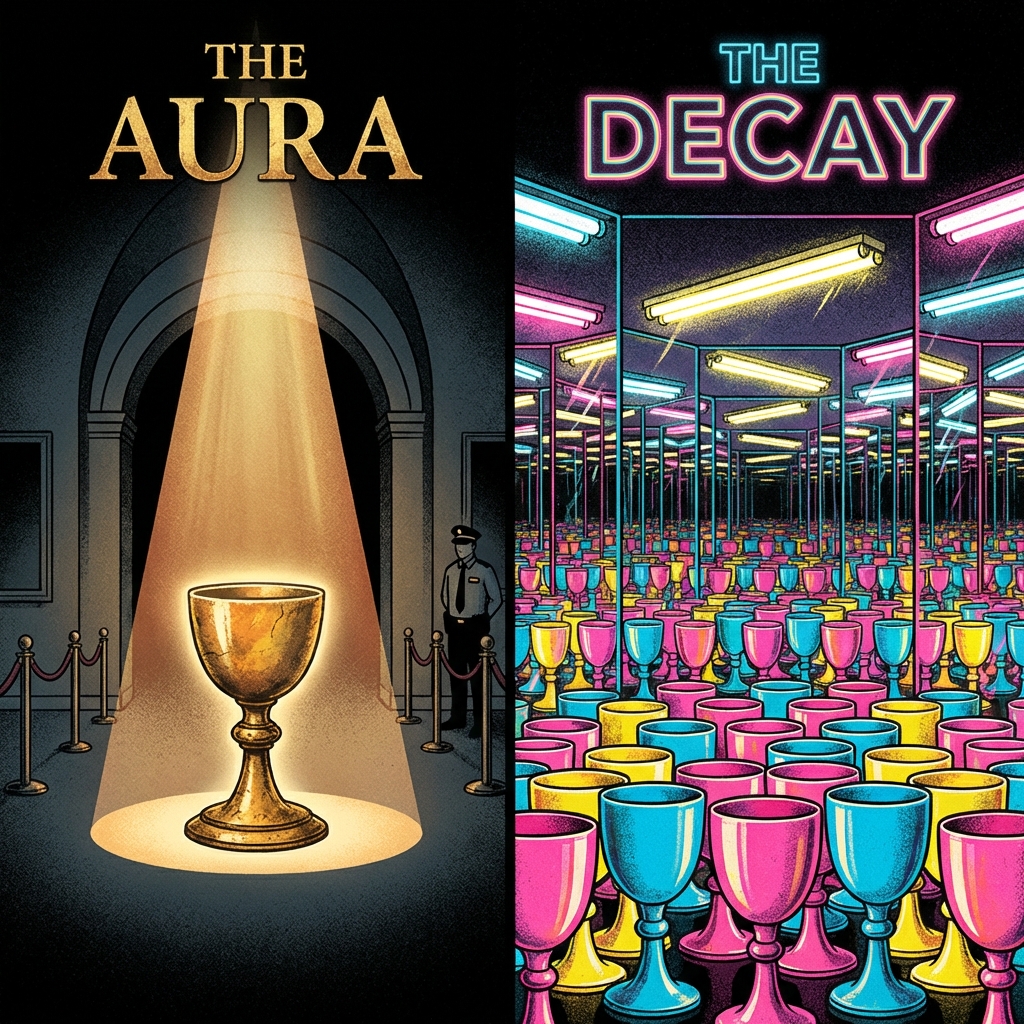
Comparison: The Sacred Aura vs The Infinite Hall of Mirrors
The Aura (Unique)

Defined by distance, history, and singular existence in space-time.

The Decay (Infinite)

Defined by closeness, ubiquity, and infinite identical copies.

When you reproduce the Mona Lisa on a postcard or a coffee mug, you kill the distance. You bring the object to the user, stripping it of its history and authority. The copy is everywhere, so the original matters less. The "here and now" of the artwork (hic et nunc) is erased.

"That which withers in the age of mechanical reproduction is the aura of the work of art."

The Aura Impact Score
Accessibility +1000% Gain

Art is no longer elitist. Everyone holds the museum in their pocket.

Historical Context -90% Loss

The image is severed from its history. It becomes "Content".

Ritual Value 0% (Total Collapse)

No pilgrimage required. The image waits for you, not vice versa.

The Optical vs. The Computational Unconscious

One of Benjamin’s most fascinating concepts was the "Optical Unconscious." He argued that the camera revealed worlds our eyes could not see. Slow-motion revealed the mechanics of a horse’s gallop; the close-up revealed the texture of skin. The camera introduced us to a reality that was there, but invisible to the naked eye.

In 2026, we are navigating the Computational Unconscious.

Just as the camera revealed the physical world, AI models reveal the informational world. A model like Stable Diffusion or Midjourney has "seen" billions of images—more than any human could view in a thousand lifetimes. It has compressed the entire history of human visual culture into a few gigabytes of vectors.

When we prompt a model, we are not creating; we are excavating. We are dipping a bucket into the ocean of the collective unconscious (the training data) and pulling up a cup of water. The "Computational Unconscious" reveals the statistical connections between concepts—the way "cyberpunk" correlates with "neon" and "rain" in the collective human dataset.

The Zero Marginal Cost of Creativity

The crisis of the digital age is economic as much as it is aesthetic. In Benjamin’s time, making a film was still expensive. It required silver, celluloid, actors, and laboratories. Scarcity was still a constraint.

In our time, the marginal cost of creating a "masterpiece" is approaching zero. Value is inextricably linked to friction. If a gold nugget were as common as gravel, gold would have no value. Generative AI removes the friction. When a user can generate 1,000 variations of a "Sunset over Tokyo in the style of Van Gogh" in five minutes, which one matters? The answer is: none of them.

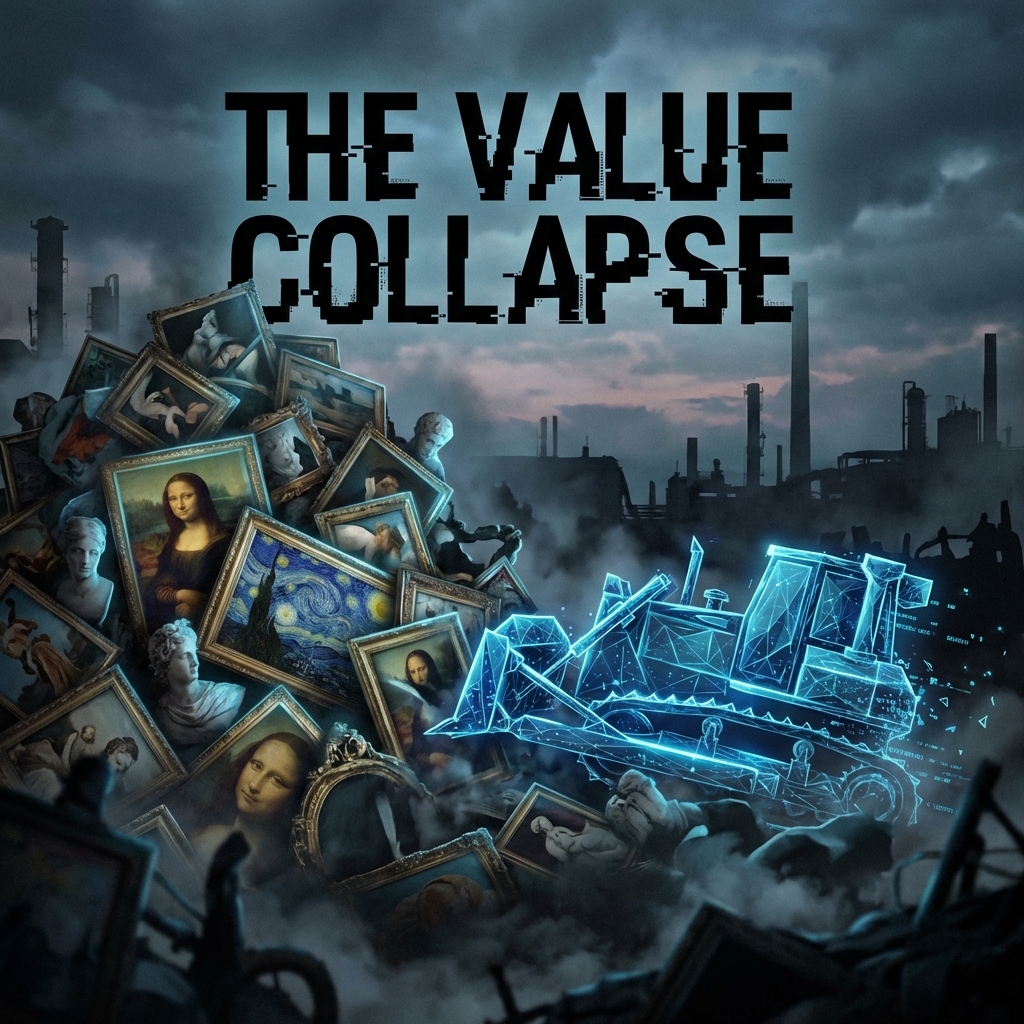
Surreal Illustration: The Value Collapse - Masterpieces bulldozed by digital noise

Figure 2: The "Inflation of Beauty". When supply becomes infinite, value crashes.

From Ritual to Algorithm

Benjamin argued that art began in Ritual (cave paintings meant for spirits). It then moved to Politics/Exhibition (art meant to be seen by the masses). Where does AI take us?

It takes us to Data. The function of an image in 2026 is no longer to be "worshipped" or even "understood." Its function is to be processed. Processed by algorithms to drive engagement, and processed by eyes to provide a dopamine hit before the next scroll.

Benjamin warned that as art loses its ritual foundation, it becomes "designed for reproducibility." Today, art is "designed for virality." We see this in the "Midjourney Look"—that hyper-detailed, high-contrast, dramatic lighting style that dominates the web. It is a style evolved to please the algorithm, not the human.

The Political Warning: The Aestheticization of Reality

Benjamin ended his essay with a chilling warning about Fascism. He observed that Fascism allows the masses to express themselves (through rallies, symbols, and spectacles) without changing the property relations. He called this the "Aestheticization of Politics."

In the age of Generative AI, this has reached its terrifying zenith: The Deepfake. Benjamin worried about the photograph lying; today, we worry about the video hallucinating. When AI can generate a photorealistic video of a politician accepting a bribe or declaring a war that never happened, reality itself becomes an aesthetic choice.

This is the ultimate fulfillment of Benjamin’s fear. Politics becomes a pure design challenge. The winner is not the one with the better policy, but the one with the better prompt engineer.

The Resurrection of the Aura?

But perhaps we are being too pessimistic. Benjamin was a dialectical thinker; he saw the destruction of the old as the prerequisite for the new. Maybe the "Aura" isn't dead; it has just migrated.

In the AI age, the "Aura" does not reside in the final image (which is endlessly reproducible). It resides in the Curation and the Prompt. If the machine can generate 1,000 images, the act of art becomes the act of selection. The human act of filtering the 99 bad generations to find the 1 good one becomes the new artistic ritual.

"The illiterate of the future will not be the man who cannot take a photograph, but the man who cannot prompt."

Or perhaps, more accurately: "The illiterate of the future will be the man who cannot distinguish the prompt from the reality."

— Adapted from Walter Benjamin, 1931

As we drift further into the latent space, Benjamin’s ghost floats beside us. He warns us that while we have gained the godlike power of creation, we risk losing the very thing that made art human: its struggle against time, its grounding in reality, and its fragile, fleeting aura.

Related Video
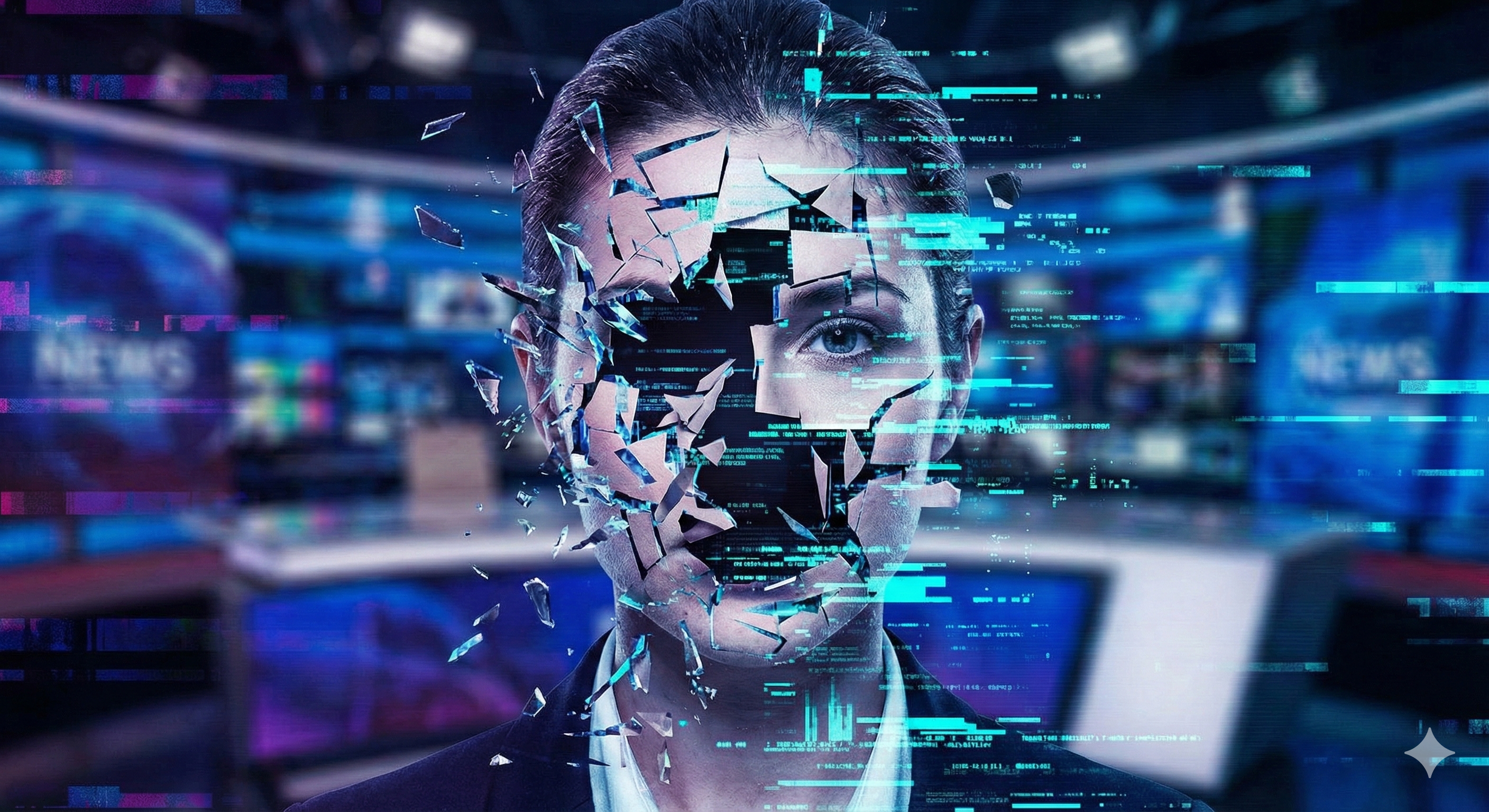
Deepfakes and Truth
Ethics 15 January 2026

Deepfakes and the Erosion of Truth

In an era where seeing is no longer believing, we are witnessing the collapse of digital trust. From the "Liar's Dividend" to the $200 million fraud economy, we explore how synthetic media is reshaping our reality—and the technical protocols fighting to restore it.

The Age of Epistemic Exhaustion

For most of human history, the visual record was the ultimate arbiter of truth. If you saw a photograph or video of an event, you knew it happened. That certainty has now evaporated. We have entered a period researchers call "epistemic exhaustion"—a state where the constant bombardment of synthetic media leaves the public unable to distinguish fact from fiction, leading to a general atmosphere of doubt.

The numbers paint a stark picture of this acceleration. Between 2021 and 2023 alone, the volume of deepfakes online increased by 31 times. By the end of 2025, it was estimated that 8 million deepfakes were being shared annually, doubling every six months. This isn't just a nuisance; it is a fundamental restructuring of our information ecosystem.

The psychological toll of this shift is profound. When our senses—the very tools we use to navigate the world—can no longer be trusted, we retreat into information silos. We trust only what confirms our existing biases because everything else could be fake. This fragmentation is the fertile ground in which disinformation campaigns thrive.

The Financial Toll: A $200 Million Quarter

While the cultural damage is abstract, the financial damage is brutally concrete. In the first quarter of 2025 alone, deepfake-enabled fraud resulted in over $200 million in losses globally. The days of the "Nigerian Prince" email scam are over; today's cybercriminals are film directors.

The most high-profile example of this occurred in early 2024, when an employee at the engineering firm Arup was tricked into transferring $25 million to fraudsters. The employee had initially been suspicious of a phishing email, but their fears were allayed when they joined a video conference call with their Chief Financial Officer and several other colleagues. The catch? Everyone else on the call was a deepfake, generated in real-time to mimic the voices and faces of the company's leadership.

This vector of attack—known as "Business Email Compromise" (BEC) on steroids—is becoming commonplace. Scammers need as little as three seconds of audio, often scraped from a podcast or YouTube video, to create a voice clone with an 85% match to the original speaker.

$200,000,000
Q1 2025 Deepfake Fraud Losses
"The Nigerian Prince has been replaced by the CEO Voice Clone."

The Liar's Dividend: A New Political Weapon

Perhaps the most insidious danger of deepfakes is not that they fool us into believing lies, but that they allow liars to dismiss the truth. This phenomenon was coined by law professors Bobby Chesney and Danielle Citron as the "Liar's Dividend".

As the public becomes more aware that video can be forged, politicians and corporate leaders caught in genuine scandals can simply shrug and claim, "That's AI." We saw early warning signs of this in the 2024 US election cycle, where AI was repeatedly used as a scapegoat to dodge accountability.

It creates a "zero-trust" environment where genuine evidence—video of a crime, a recording of a bribe, or footage of police misconduct—loses its power to hold power to account. When everything could be fake, the truth becomes just another opinion.

The Liar's Dividend Cycle
📹
Real Scandal

Video Evidence Exists

🤥
"It's Just AI"

The Universal Defense

🗑️
Truth Dead

Public Confusion

"When everything can be fake, the guilty go free."

The Gendered Violence of Synthetic Media

It is impossible to discuss deepfakes without addressing their primary use case. Despite the headlines about election interference and corporate fraud, the vast majority of deepfake content online—estimates range from 96% to 98%—is non-consensual intimate imagery (NCII), targeting overwhelmingly women.

This is a form of digital violence that is difficult to police and nearly impossible to erase. Once a synthetic image is uploaded to the decentralized web, it can persist forever. The psychological impact on victims mirrors that of physical abuse, leading to anxiety, depression, and social withdrawal. While legislation is slowly catching up—with the UK and US passing stricter laws in 2024—the technology moves faster than the gavel.

Target Demographic 96% Women
Non-Consensual Imagery Other (4%)

The Failure of Detection

For years, the hope was that we could build "deepfake detectors"—software that spots the artifacts of generation. We now know this was a losing battle. Generative Adversarial Networks (GANs) are designed specifically to outsmart discriminators; every time a detector gets better, the generator learns from it and improves.

Furthermore, as we moved into 2025, the "tells" we used to rely on—unblinking eyes, weird hands, inconsistent lighting—have largely been solved by newer diffusion models. Relying on naked-eye detection is no longer a viable strategy for the average citizen.

🐱 ⚔️ 🐭
The Detector's Dilemma

"Every time a detector gets better, the generator uses it to learn how to hide better."

The Solution: Provenance, Not Detection

If we can't detect the fake, we must verify the real. This has led to the rise of the C2PA (Coalition for Content Provenance and Authenticity) standard, often referred to as "Content Credentials".

Think of C2PA as a tamper-evident digital seal for media. It doesn't judge whether an image is "true," but it records its history.
1. Creation: When a photo is taken on a C2PA-enabled camera (now standard in models from Sony, Nikon, and Leica), it is cryptographically signed at the hardware level.
2. Editing: If that photo is opened in Adobe Photoshop, the software adds a record of the edits (e.g., "cropped," "color corrected") to the manifest.
3. Distribution: When the image is posted online, the browser can check the signature. If the metadata matches the pixel data, a "verified" icon appears.

However, this system relies on adoption. If major social platforms strip this metadata (as many did prior to 2025), the chain of custody is broken. It also creates a two-tier system: "verified" content from major publishers, and everything else.

The C2PA Trust Protocol
📸
Origin

Cryptographic Seal

Hardware signs the pixel data at the exact moment of capture.

🧬
Provenance

Edit History

Every change (crop, AI fill, filter) is appended to the ledger.

🛡️
Verification

Consumer Trust

Browser checks the signature.
"Verified" Badge appears.

Cognitive Security: The Human Firewall

Technology alone cannot save us. We must upgrade our own "cognitive security." Media literacy in the AI era is no longer just about checking sources; it is about understanding how our own brains can be hacked.

Psychological research shows that deepfakes trigger an "amygdala hijack"—a fear response that bypasses our critical thinking. When we see a trusted figure saying something outrageous, our brain prioritizes the emotional reaction over logical scrutiny. This "familiarity heuristic" is exactly what bad actors exploit.

The most effective defense is a "pause-reflect" routine. When you encounter content that elicits a strong emotional reaction—whether rage or validation—that is the moment to be most skeptical. In a world of infinite synthetic media, skepticism is not cynicism; it is a necessary survival skill.

Surrealism 2.0: The Latent Unconscious
Art History 20 December 2025

Surrealism 2.0: The Latent Unconscious

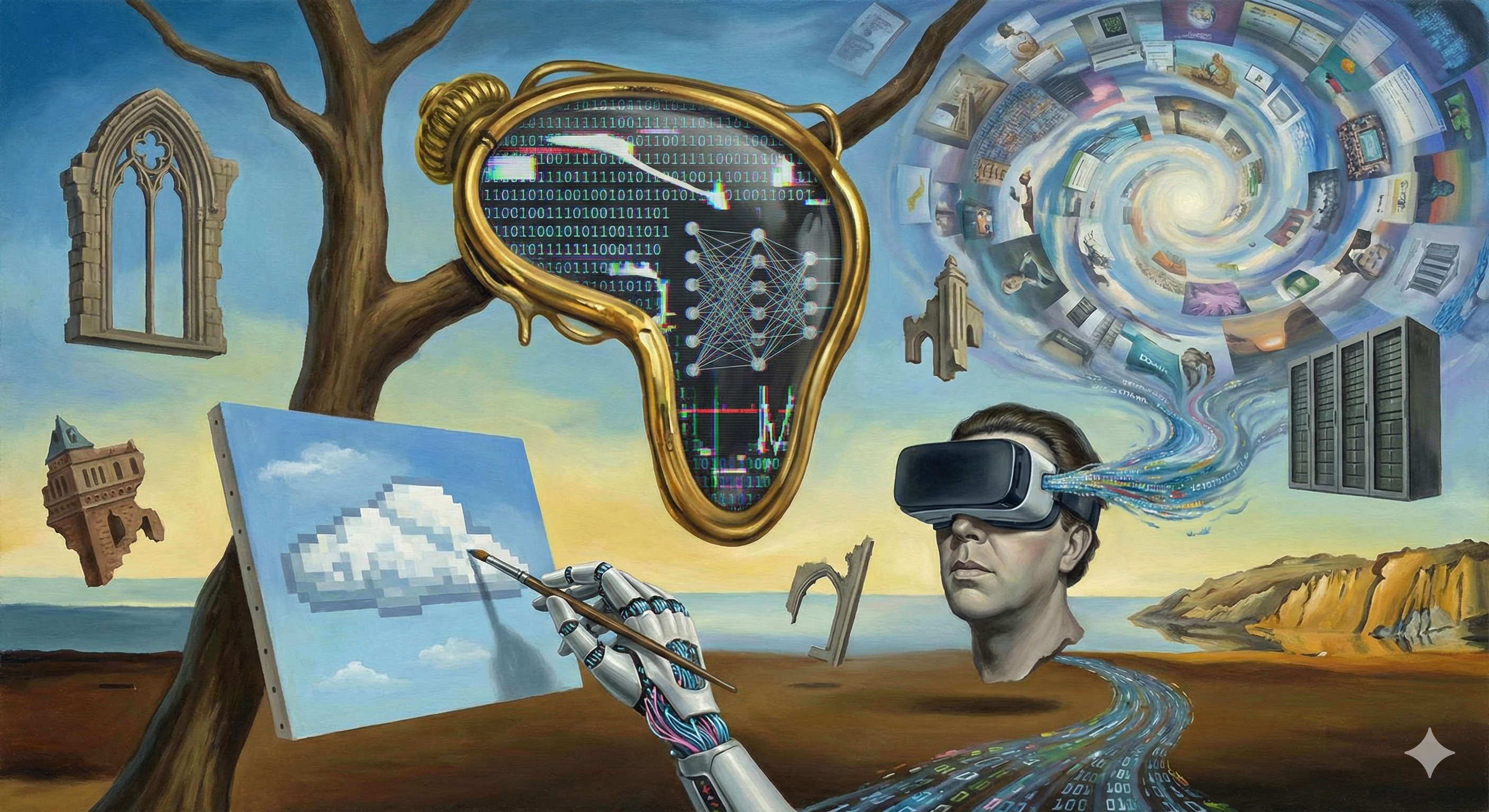
André Breton defined Surrealism as "pure psychic automatism." One hundred years later, generative AI has fulfilled this prophecy—not through human psychology, but through the "hallucinations" of the machine. An in-depth exploration of the century-long echo between 1924 and 2024.

It is a strange irony of history that the technology most feared by artists—Generative AI—is the exact fulfillment of the dream they have been chasing for a century. In 1924, in a dusty apartment in Paris, the poet André Breton published the Surrealist Manifesto. He defined his movement with a specific, rigid ambition:

"Surrealism, n. Psychic automatism in its pure state... Dictated by thought, in the absence of any control exercised by reason, exempt from any aesthetic or moral concern."

Breton and his cohorts (Dalí, Magritte, Ernst) spent their lives trying to hack the human brain. They wanted to bypass the "editor"—the logical, rational part of the mind—and print the raw contents of the unconscious directly onto the canvas. They used hypnosis, dream journals, and "automatic writing" to try and generate images that were free from the constraints of physics and logic.

They barely succeeded. The human mind is too disciplined. Even when hallucinating, we seek order.

But in 2024, exactly one century later, we finally built the machine they were looking for. We trained a neural network on 5 billion images, severed it from any understanding of physics or truth, and gave it a "Temperature" setting to control its hallucinations. We built the "Pure Psychic Automaton."

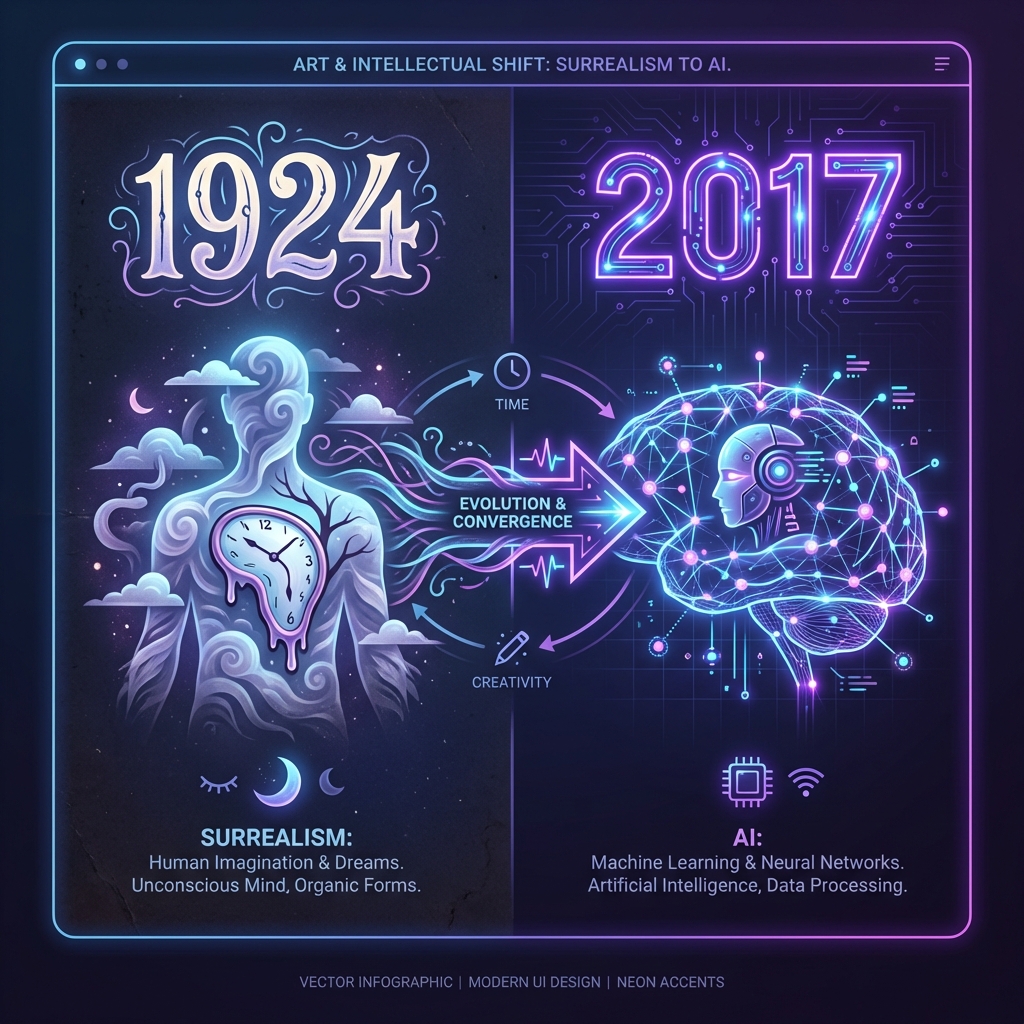
1924 Surrealism vs 2017 AI Architecture

From the Human Unconscious to the Machine Latent Space.

Part I: The Architecture of the Digital Dream

To understand why AI art looks "Surrealist," we must stop looking at the images and start looking at the math. A Diffusion model (like Stable Diffusion) does not "paint." It does not know what a brush is. It does not know what light is. It knows only one thing: Probability.

Freud described the dream-work as operating through two main mechanisms: Condensation (fusing two concepts into one) and Displacement (shifting emotional meaning from one object to another). In the 20th century, these were psychological metaphors. In the 21st century, they are vector operations.

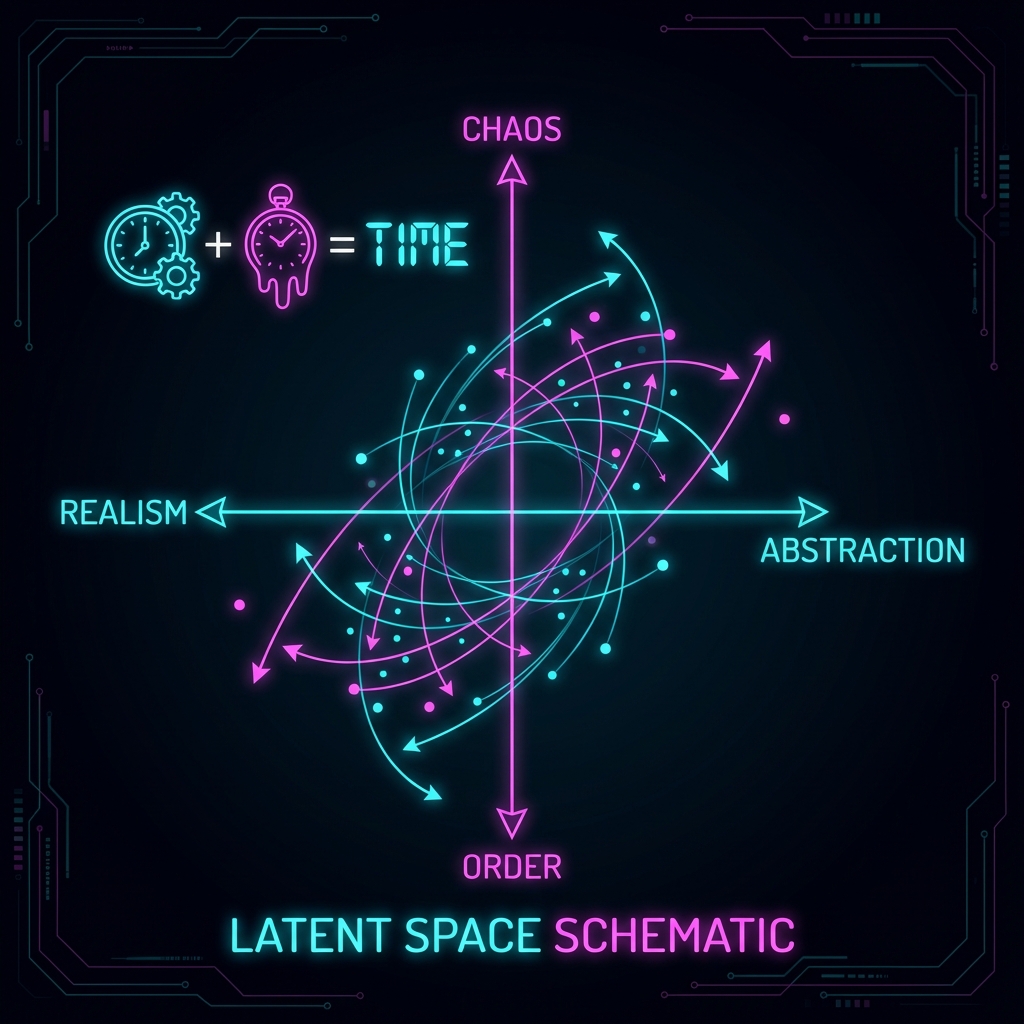
Diagram: The Vector Math of Surrealism

Figure 1: Navigating the 'Latent Space'. Concepts like 'Time' and 'Melting' are just coordinates.

When you prompt a model with "A clock melting over a tree," the model does not "imagine" this scene. It locates the vector for "Clock" in its high-dimensional space (Latent Space). It locates the vector for "Tree." It then calculates the mathematical midpoint between them. In this midpoint, the features of the clock and the tree are Condensed.

This is why AI struggles with hands. A hand, to a human, is a functional tool with five rigid digits. A hand, to an AI, is a "statistical cloud of flesh-colored texture often found near the end of an arm." The AI doesn't know bones exist. It only knows surface topology. When it generates a hand with seven fingers, it isn't "failing"—it is dreaming. It is generating a "Hand-concept" that is statistically probable but physically impossible.

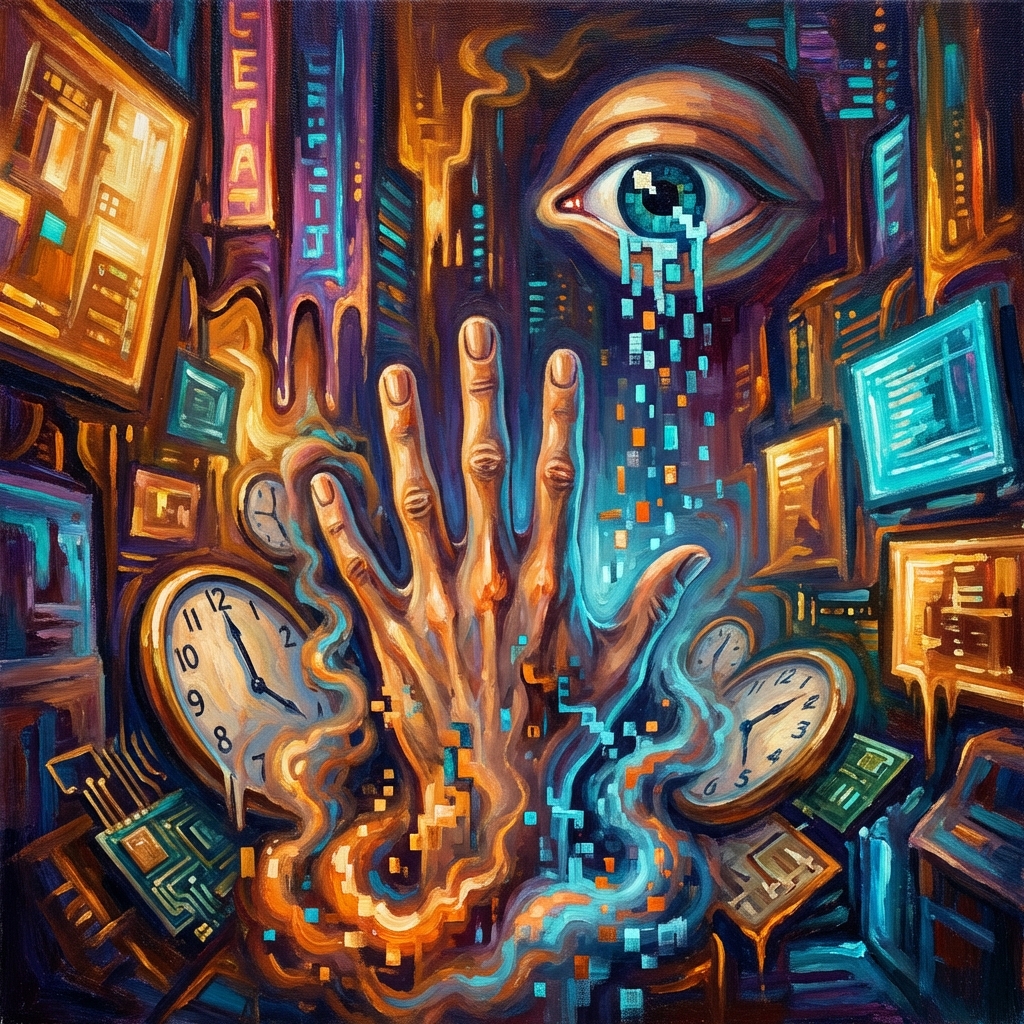
The Glitch as Aesthetic

Hover over the image to see the anatomy of the glitch.

Part II: The Uncanny Valley as an Artistic Destination

For decades, roboticists have feared the "Uncanny Valley"—that dip in emotional response where a robot looks almost human, but not quite, triggering a primal revulsion in the viewer. We viewed this valley as a failure state.

Surrealism 2.0 flips this script. It treats the Uncanny Valley not as a place to avoid, but as a destination. The "weirdness" of AI art—the glossy skin, the dead eyes, the impossible geometries—is becoming its own aesthetic signature. We are beginning to crave the artificial.

Just as the invention of the camera pushed painting toward Abstract Expressionism (since reality was already captured), the perfection of 3D rendering is pushing AI art toward the Grotesque. If anyone can generate a perfect photo of a sunset, the value of a sunset drops to zero. The value shifts to the things that cannot exist.

The Uncanny Valley: Why We Like 'The Weird'

Emotional Affinity vs. Human Likeness

Part III: The Death of the Author, The Birth of the Director

The most heated debate in the art world today is about "Authorship." If I type "A man in a bowler hat with a green apple floating in front of his face" into Midjourney, did I create that image? Or did I just order it from a menu?

The Surrealists invented a game called Exquisite Corpse. One artist would draw a head, fold the paper, and pass it to the next artist, who would draw the torso without seeing the head. The final image was a collective accident—a collaboration between artists who didn't know they were collaborating.

Generative AI is the ultimate game of Exquisite Corpse. The "Training Data" is the folded paper. It contains the brushstrokes of millions of artists—alive and dead, famous and unknown. When we prompt the model, we are unfolding the paper. We are collaborating with the ghost of the entire human race.

"The artist of the future will not painting with pigments, but with concepts. The prompt is the new paintbrush, and the latent space is the new canvas."

This does not mean human creativity is dead. It means it is migrating. It is moving upstream. We are no longer the bricklayers of the image; we are the architects. The technical skill of physically mixing paint is being replaced by the conceptual skill of Prompt Engineering (which is really just a fancy word for "Poetry").

The illiterate of the future will not be the one who cannot draw. It will be the one who cannot describe their dreams.

Digital Renaissance: Marble to Polygons
Art History 12 January 2026

The Digital Renaissance: Silicon is the New Marble

History is rhyming. Just as the printing press and the Medici family shaped the 15th century, generative AI and the "Tech Giants" are sculpting a new era of creative explosion. But in a world of infinite content, where is the value?

The word "Renaissance" means rebirth. It refers to that explosive period in European history (roughly 1400–1600) where art, science, and philosophy accelerated at a velocity never seen before. We often attribute this to individual genius—names like Da Vinci, Michelangelo, and Raphael. But historians know the truth: the Renaissance wasn't just about talent. It was about technology and capital.

It was the printing press spreading ideas. It was the invention of oil paint allowing for new textures. It was the discovery of linear perspective allowing for 3D realism. And, perhaps most importantly, it was the Medici family bankrolling the disruption.

Today, we are living through a mirror image of that era. The "Digital Renaissance" is not a metaphor; it is a structural repetition of history. But instead of oil paint, our medium is the neural network. And instead of the Medicis of Florence, our patrons are the tech giants of Silicon Valley.

The New Perspective: Latent Space

In 1415, the architect Filippo Brunelleschi demonstrated linear perspective. Suddenly, flat medieval paintings had depth. Artists could simulate reality.

In 2022, we discovered "Latent Space." This is the mathematical multi-dimensional void where AI models store their understanding of concepts. Just as perspective allowed Renaissance artists to navigate 3D space on a 2D canvas, Latent Space allows modern creators to navigate conceptual space. We can mathematically move from "Cyberpunk" to "Art Nouveau" as easily as moving a camera.

🏛️
1415 AD

Linear Perspective (3D)

X, Y, Z
🧠
2025 AD

Latent Perspective (ND)

Vector[512]

"We no longer map space. We map meaning."

"When you can generate 1,000 images in an hour, the artist's job shifts from 'maker' to 'editor'. The value is no longer in the brushstroke, but in the decision to keep it."

The Modern Medicis: Algorithmic Patronage

The Italian Renaissance didn't happen in a vacuum. It was funded by the House of Medici, a banking dynasty that used art to project power and shape public opinion. They were the gatekeepers of culture.

Today's "Medicis" are the cloud compute providers: Microsoft (OpenAI), Google, and NVIDIA. They own the infrastructure of imagination. This centralization of power creates a complex tension. While the tools of creation are democratized (accessible to anyone with a subscription), the means of production are controlled by a few monopolies.

This leads to the "Liar's Dividend" we discussed in previous articles, but it also leads to an "Algorithmic Style." Just as you can spot a Medici commission by its grandeur, you can often spot a Midjourney V6 image by its specific lighting and composition bias. We must ask: are we creating our own art, or are we just exploring the aesthetic biases of our new patrons?

The "New Medicis" (Compute Providers)
☁️💾
The Digital Artist

Dependent on API Access

The Art

"In the style of the Model"

The Inflation of Beauty

The most controversial aspect of this Renaissance is the "Inflation of Beauty." In 2020, a high-fidelity, photorealistic digital painting required 40 hours of expert labor. In 2025, it requires 4 seconds of compute time.

Economic theory tells us that when supply becomes infinite, price approaches zero. We are seeing this play out in the concept art and illustration markets. "Beautiful" is no longer scarce. "Impressive" is no longer difficult. This has caused a crisis of meaning for many traditional artists, who feel their years of technical training have been devalued.

"The Collapse of Scarcity: High Art at Low Cost."

However, history suggests a counter-intuitive outcome. When photography killed the market for realistic painted portraits, painting didn't die. It invented Impressionism, Cubism, and Abstract Expressionism. It moved to places the camera couldn't go. Similarly, as "perfect" AI imagery becomes free, human artists are moving toward the physical, the flawed, the raw, and the conceptual. We are seeing a resurgence in traditional media—oil, clay, film photography—precisely because it is hard to do.

Democratization or Dilution?

Proponents argue this is the ultimate democratization. A paralyzed person can now paint with their mind. A writer with no drawing skills can illustrate their novel. The "idea" is finally king, liberated from the tyranny of manual dexterity.

Critics, however, argue this is not democratization but dilution. If everyone is an artist, no one is. They point to the flood of AI-generated content (slop) clogging social media feeds, making it harder to find genuine human connection. The "signal-to-noise" ratio of the internet has plummeted.

The truth, as always, lies in the middle. The printing press led to a flood of propaganda and trash novels, but it also gave us the scientific revolution. The Digital Renaissance will likely produce 99% noise and 1% of the most profound art humanity has ever seen. The job of the modern curator—and the modern viewer—is to find that 1%.

Top 1% Human Curation
The Flood Infinite Synthetic Noise

"Value migrates to the filter, not the source."

The Denoising Process Visualization
Technology 22 January 2026

From Noise to Image: How Diffusion Models Work

Generative AI doesn't "paint" in the traditional sense. It hallucinates structure out of chaos. We break down the technical process of "Denoising" used by Stable Diffusion and Midjourney.

The Alchemy of Static: Deconstructing the Diffusion Miracle

We used to think of digital art as "painting with pixels." We thought the computer was the canvas and the mouse was the brush. We were wrong.

The latest generation of AI—Diffusion Models—has more in common with archaeology than it does with painting. It does not build images; it rescues them. It pulls structure out of chaos. To understand why this matters, we have to look under the hood of the machine that killed the blank canvas.

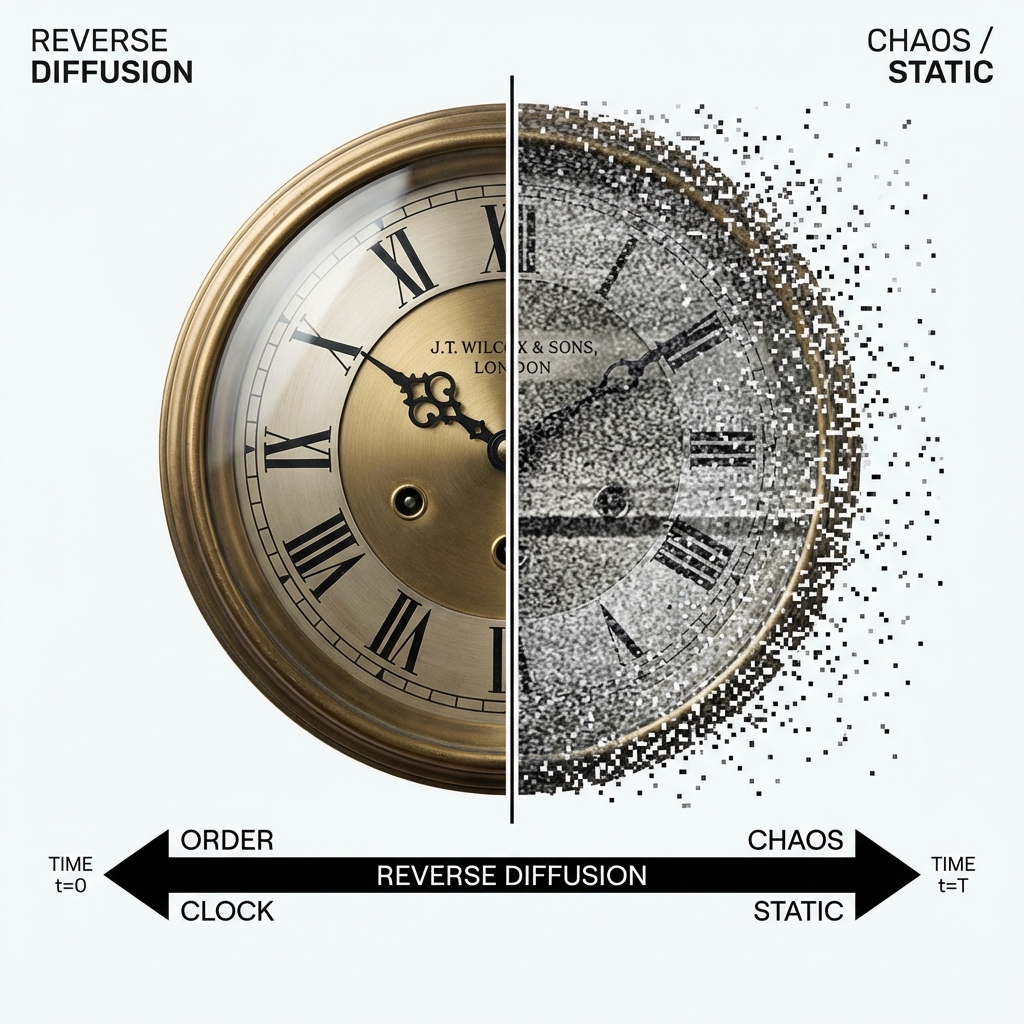
Clock dissolving into static: Reverse Diffusion

Chaos to Order: The Denoising Process

The Great Denoising (Reverse Diffusion)

To understand how a machine "dreams," you first have to understand how it learns to see. And paradoxically, it learns to see by destroying things.

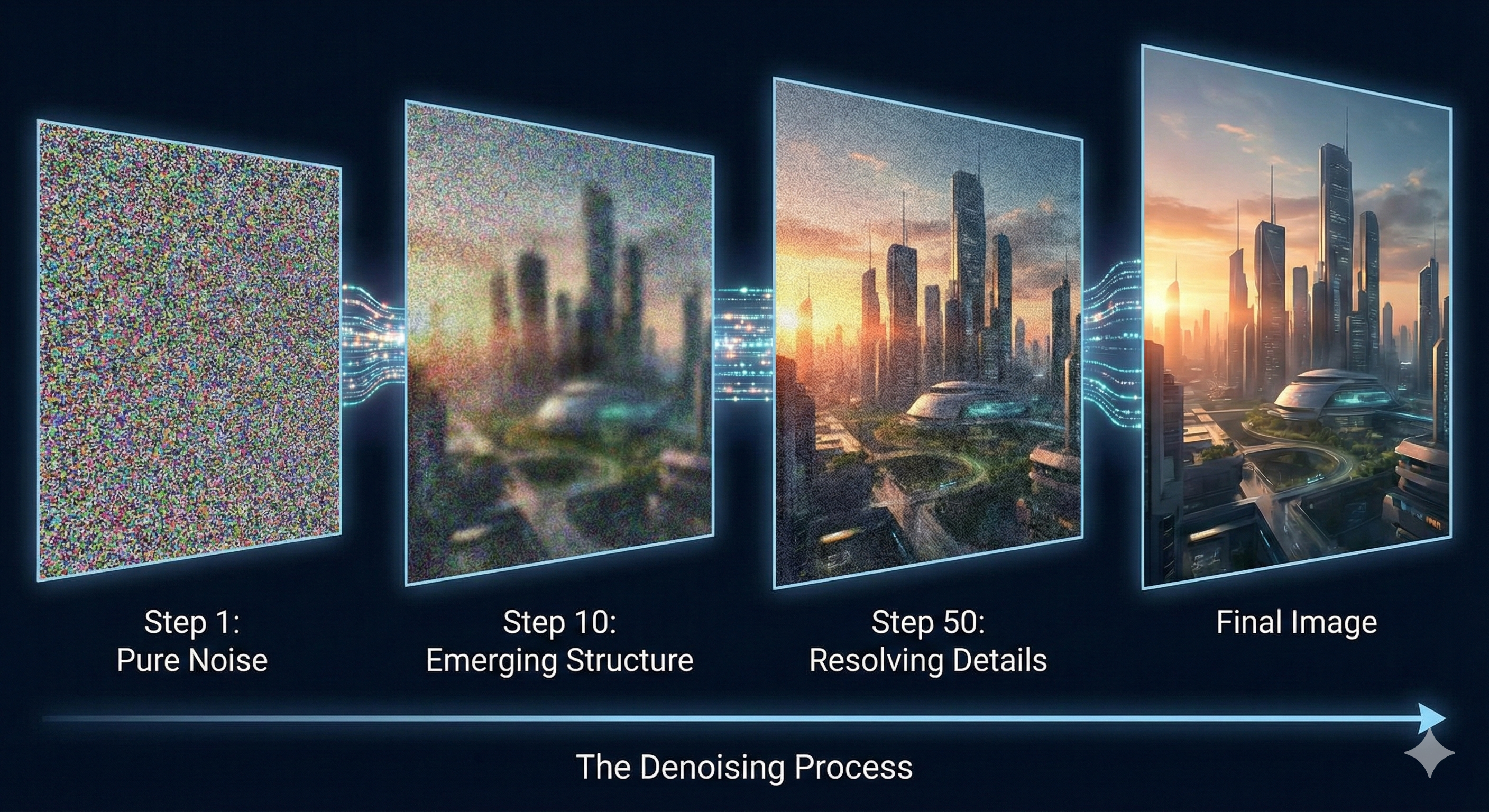
Imagine you have a pristine photograph of a cat. Now, imagine adding a transparent layer of "static" or "noise" over it—just a dusting of random pixels, like snow. The cat is still visible, but slightly grainy. Now add another layer. And another. And another. If you repeat this process a thousand times, the cat eventually disappears entirely. You are left with pure, Gaussian noise—a square of digital chaos that contains zero information.

This destruction is the training process. The AI watches this happen to billions of images. It watches the structure of the world dissolve into entropy.

But then, the engineers ask the machine to do the impossible: Play the tape backward.

They present the AI with a square of pure static and ask, "What image used to be here?" Mathematically, this should be impossible. There are infinite ways those random pixels could be arranged. But the AI has seen so many examples of how structure dissolves that it can make a probabilistic guess. It looks at a patch of grey pixels and thinks, “Based on the billions of images I’ve studied, this specific pattern of static usually occurs where an ear meets a background.”

It doesn’t try to recreate the whole image at once. That would be like trying to guess the ending of a novel from the first word. Instead, it moves in steps. It gently nudges the pixels, subtracting a tiny fraction of the noise. It reveals a ghostly outline. It looks again, with a slightly clearer view, and subtracts a little more noise. It repeats this process—the "Denoising Loop"—dozens or hundreds of times.

This is Reverse Diffusion.

It is the reason why AI images often feel so dreamlike. The model isn't retrieving a stored Jpeg from a hard drive. It is hallucinating a new image on the fly, guided by your text prompt. When you type "A cyberpunk city," you are essentially giving the AI a flashlight in a dark room. You are telling it, "I want you to find a city in this static."

The text prompt acts as a filter for the probabilities. Without the prompt, the AI might resolve the static into a dog, a landscape, or a face. The prompt biases the math. It tells the model, "Ignore the probability curves that lead to 'Dog' and follow the curves that lead to 'Neon Skyscrapers'."

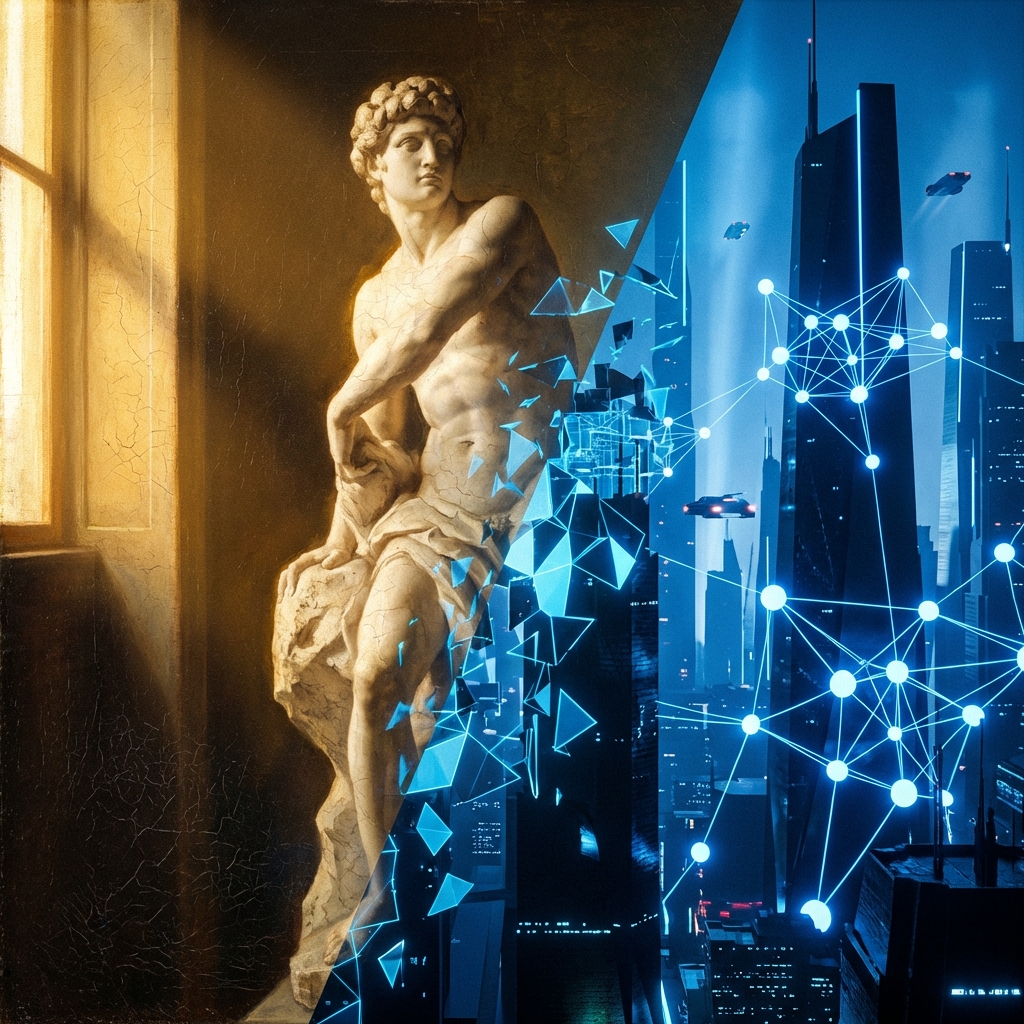
This fundamentally changes the definition of "creation." In this workflow, the image already exists within the noise—mathematically speaking, every possible image exists within the noise—waiting for the right prompt to collapse the wave function. The machine is not a painter; it is a sculptor chipping away the marble of chaos to reveal the statue inside.

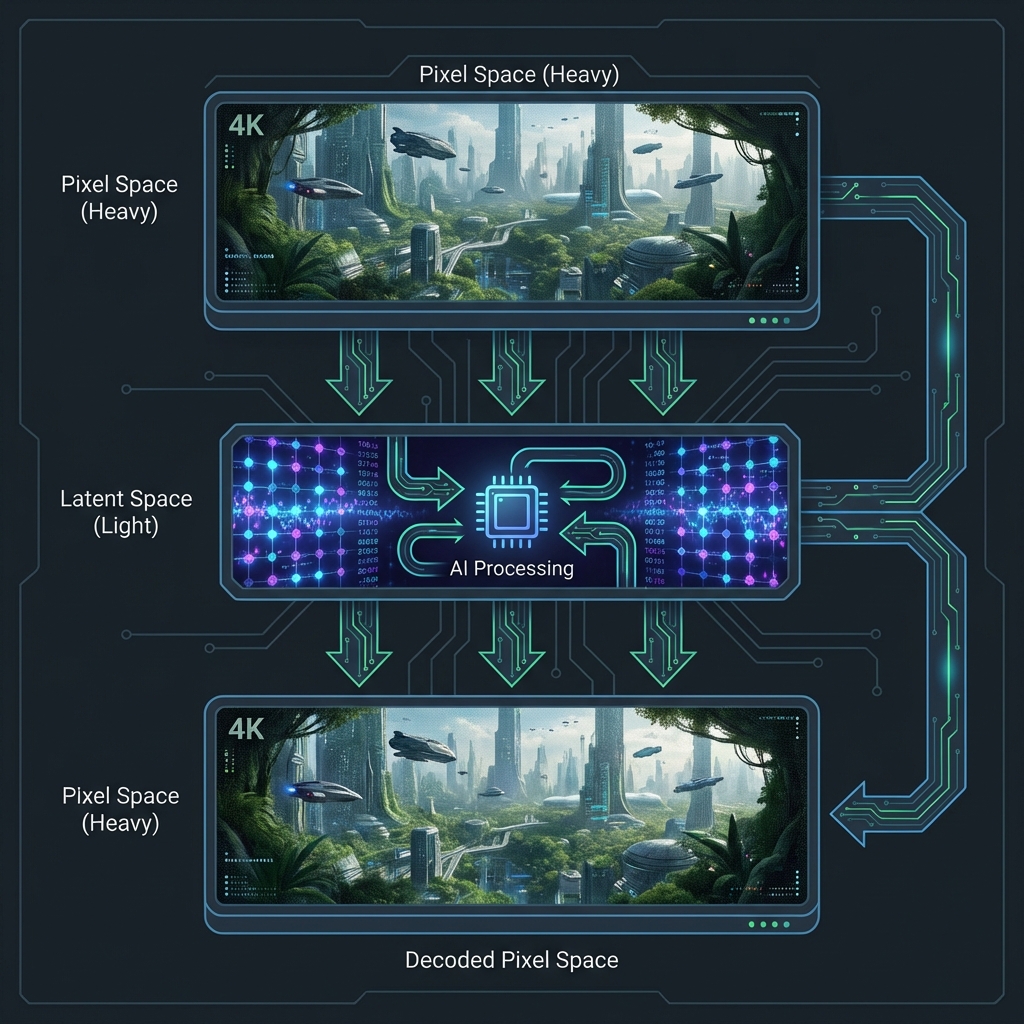
Pixel Space vs Latent Space Infographic

We don't process pixels; we process 'Meaning' (Latent Vectors).

The Latent Space Revolution (Why It’s Fast)

If Reverse Diffusion is the "magic," then Latent Diffusion is the engineering breakthrough that made the magic affordable.

In the early days of generative AI, researchers faced a massive computational bottleneck. If you wanted to generate a high-resolution image—say, a 1024x1024 pixel portrait—the AI had to calculate the color values for over a million individual pixels. To run that "denoising" process (which we just discussed) on a million pixels, fifty times over, required a supercomputer. It was slow, expensive, and inaccessible to anyone without a research grant.

Enter the game-changer: a paper titled "High-Resolution Image Synthesis with Latent Diffusion Models" by Rombach et al. (2022).

The researchers realized that human vision doesn't care about every single pixel. When you look at a photo of a grassy field, your brain registers "green grass texture." It doesn't memorize the position of every blade. They realized that images contain a lot of redundant data.

Their solution was Perceptual Compression. Instead of teaching the AI to manipulate the raw pixels (Pixel Space), they trained it to manipulate a compressed representation of the image (Latent Space).

Think of it like the difference between a library filled with books and a card catalog. Pixel Space is the library itself: heavy, vast, and slow to navigate. Latent Space is the card catalog: a condensed abstract summary of what is in the books.

In a Latent Diffusion Model (like Stable Diffusion), the process works in three distinct stages:

Compression (The Encoder): The system takes an image and crunches it down into a tiny, mathematical representation—a "latent tensor." This file is 48 times smaller than the original image, but it retains the semantic meaning (the "idea" of the image).

Diffusion (The Process): The heavy lifting—the noise prediction and removal—happens here, in this compressed space. Because the data is so much smaller, the math is exponentially faster. This is why you can run Stable Diffusion on a gaming laptop instead of a server farm. The AI is dreaming in shorthand.

Decompression (The Decoder): Once the noise is removed and the "latent" image is clear, the system blows it back up into full-resolution pixels that human eyes can understand.

This separation of powers is what democratized AI art. Before Latent Diffusion, this technology was the exclusive domain of tech giants like Google and OpenAI. After Latent Diffusion, it became open-source software that a teenager could run in their bedroom.

The Latent Advantage

Computational Load: Pixel Space vs. Latent Space

By compressing the image by 48x, we make the math 48x faster.

The Philosophical Shift (The Eraser is the Brush)

The mechanics of Diffusion Models force us to confront a philosophical inversion that the art world hasn't seen since the invention of photography. For all of human history, artistic creation has been an additive process.

A painter starts with a blank white canvas. This "blankness" is an emptiness. To create, the painter must add pigment. Every stroke is a positive assertion of existence. The writer starts with a blank page and adds words. The composer starts with silence and adds notes. We are conditioned to believe that creativity is the act of bringing something into existence where there was previously nothing.

Diffusion Models operate on a subtractive logic.

The AI does not start with a blank canvas. It starts with a canvas full of noise—a canvas that is technically full of everything. Gaussian noise is a mathematical soup containing the potential for every pixel combination possible. It is a block of marble that contains every statue, a library that contains every book.

Therefore, the act of "prompting" is not an act of construction. It is an act of curation. It is an act of removal.

When you tell the AI "A portrait of an astronaut," you are not asking it to build an astronaut. You are asking it to look at the noise and remove everything that is not an astronaut. You are asking it to carve away the static that looks like a toaster, the static that looks like a tree, and the static that looks like a car, until only the astronaut remains.

"The sculpture is already complete within the marble block, before I start my work. It is already there, I just have to chisel away the superfluous material."

— Michelangelo

For centuries, this was a poetic metaphor for human genius. Today, it is the literal instruction manual for our software.

What does this mean for the human artist? It means a shift in role from "Laborer" to "Director." The value of the artist is no longer found in the ability to physically execute the brushstroke—the machine can do that faster and with more fidelity than any human hand. The value is now found entirely in the Intent.

If the machine can generate anything, the only question that matters is: What should we generate?

The "Eraser is the Brush" philosophy suggests that the future of art isn't about technical skill (how to mix paints, how to draw perspective). It is about vision (what to reveal). In a world where the noise contains infinite possibilities, the artist is the one who decides which signal is worth saving. We are no longer the builders of the image; we are the architects of the search. We are not making the water; we are simply digging the channel for it to flow.

Code Syntax merging with Magical Runes
Technology 14 January 2026

Prompt Engineering: Sorcery or Syntax?

Is writing a prompt just "guessing words," or is it a high-level form of coding? We analyze the technical structure of prompts—weights, negative vectors, and parameters—to argue that we are witnessing the birth of Natural Language Programming.

Arthur C. Clarke famously wrote that "Any sufficiently advanced technology is indistinguishable from magic." When a user types "A cat eating pizza in space" and an image appears, it feels like an incantation. You speak the words, and the universe rearranges itself.

However, to treat Prompt Engineering as magic is to misunderstand the tool. Under the hood, a prompt is not a sentence; it is a packet of code. It is a set of instructions passed to a compiler (the text encoder) and executed by a processor (the diffusion model).

The Tokenizer: The Compiler of Meaning

When you type a prompt, the first thing the system does is break it down into tokens. These are not always whole words; they are chunks of characters that map to specific numerical vectors in the model's vocabulary.

A simple prompt like "Astronaut" might be one token. A complex word like "Bio-luminescence" might be split into three: `Bio`, `lumin`, `escence`. If you understand how the model tokenizes your input, you understand why changing a single synonym can drastically alter the output. You aren't changing the "vibe"; you are changing the coordinate address in Latent Space.

Vector Arithmetic: Weights and Negatives

The strongest argument for Prompt Engineering being a form of programming lies in its syntax. We use mathematical operators to manipulate the output.

Word Weights (Scalar Multiplication): In tools like Midjourney or Stable Diffusion, you can assign importance. Syntax like `(cyberpunk:1.5)` is mathematically multiplying the vector length of the concept "cyberpunk" by 1.5. You are telling the model: "Travel 50% further in this direction."

Negative Prompts (Vector Subtraction): A negative prompt is not just a filter; it is mathematical subtraction. If you prompt "Portrait" and negative prompt "Blurry," the model calculates: Vector(Portrait) - Vector(Blurry). It steers the generation away from that region of latent space.

Visualizing Token Weights (Attention Mechanism)

The model doesn't read a sentence; it assigns a scalar value (attention) to every token.

Parameters: The Function Arguments

Beyond the text, we pass explicit arguments to the function call. These are identical to parameters in Python or JavaScript:

CFG Scale (Classifier Free Guidance): This is the "obedience" parameter. A low scale (e.g., 3.0) allows the AI to be creative and ignore parts of your prompt. A high scale (e.g., 15.0) forces the AI to adhere strictly to your words, often at the cost of image quality (burning/frying). It is a direct trade-off between freedom and control.

Seed: The seed is the starting state of the random noise. In traditional coding, `random()` is never truly random; it's pseudo-random based on a seed. By controlling the seed, we make the "magic" reproducible. We turn a probabilistic process into a deterministic one.

Probabilistic Programming

So, is it programming? Yes, but not as we know it.
Traditional programming (C++, Java) is deterministic: `if X, then Y`.
Prompt Engineering is probabilistic: `if X, then likely Y, but maybe Z`.

The Context Window Decay (The "Fading Memory")

As conversation length increases, the model's ability to retain early instruction (coherence) drops exponentially.

We are not writing explicit logic loops. We are defining boundary conditions and probability weights for a neural network. It is "Natural Language Programming"—a layer of abstraction so high that the syntax is English, but the logic remains strictly mathematical.

Infinite Mirror Reflection of AI
Ethics 08 December 2025

Model Collapse: The Threat of Digital Inbreeding

We are running out of human data. As the internet floods with synthetic content, AI models are beginning to train on their own outputs. The result is a degenerative cycle known as "Model Collapse."

In ancient mythology, the Ouroboros is a serpent eating its own tail—a symbol of infinity, but also of self-destruction. Today, this symbol has become the defining fear of Artificial Intelligence researchers. It represents a phenomenon known as Model Collapse.

For the last decade, AI models were fed a healthy diet of human creation: books written by people, photos taken by photographers, and code written by developers. But as of 2026, the internet has changed. A significant percentage of the web is now generated by AI. When a new model scrapes the web for training data, it is increasingly ingesting data created by its predecessors.

The Xerox Effect

To understand why this is a problem, imagine making a photocopy of a document. It looks fine. Now, make a photocopy of the photocopy. Then do it again. By the 10th generation, the text is blurry. By the 100th, it is a black smear.

This is "Digital Inbreeding." AI models are designed to approximate the "average" of a dataset. They tend to smooth out the rough edges—the quirks, the outliers, the weird creative choices that make human art unique. When you train an AI on AI output, you are training on a smoothed-out version of reality. The variance shrinks. The colors become beige; the writing becomes repetitive; the logic dissolves.

Signal Degradation Loop
Original
Copy
Noise

MAD: Model Autophagy Disorder

In a landmark paper from Rice University, researchers coined the term Model Autophagy Disorder (MAD). They demonstrated that after just five generations of self-training, image generators develop severe artifacts. Hands become claws, faces melt, and diversity vanishes entirely.

If a model is trained only on AI-generated faces (which tend to be symmetrical and "perfect"), it eventually forgets what a "weird" human face looks like. It forgets about scars, asymmetry, and unique features. The model collapses into a single, distorted mode.

"Eventually, the model forgets what a face is."

The New Gold: Certified Organic Data

This looming crisis has created a new economic reality. "Organic Data"—text and images proven to be created by a biological human—is becoming the most valuable resource on the planet.

Tech giants are no longer just scraping the open web; they are signing exclusive licensing deals with publishers, forums, and stock photo agencies to guarantee a supply of fresh human thought. We are moving toward a bifurcated internet: the "Synthetic Web" (free, infinite, but prone to collapse) and the "Organic Web" (gated, expensive, and human).

PREMIUM
💎
Organic Data

Scarce & Human

$ High Value
🔁
Synthetic Data

Infinite & Recycled

$ Zero Value

Preserving the Outliers

The danger of Model Collapse isn't just technical; it's cultural. If our digital tools can only reproduce the "average," we risk losing the "extraordinary." Innovation happens at the edges, not in the center.

To save AI, we ironically need to save humanity. We need to ensure that human artists, writers, and coders continue to create, not just for the sake of art, but to provide the fresh genetic material required to keep the digital ecosystem alive.

"Innovation happens at the edges. AI eats the edges."

3D Gaussian Splatting Visualization
Technology 24 November 2025

Beyond Pixels: Generative 3D and the Death of the Polygon

The flat screen is no longer enough. We explore the transition from 2D diffusion to 3D generation, explaining how "Gaussian Splatting" is rendering the traditional polygon obsolete and building the Metaverse in real-time.

For thirty years, the video game and VFX industries have relied on a single fundamental unit: the Polygon. Every character in Fortnite, every building in Grand Theft Auto, and every dinosaur in Jurassic Park is essentially an origami shell made of thousands of tiny triangles.

This method, known as Rasterization, has served us well. But it has hit a ceiling. Polygons are rigid. They are computationally expensive to light realistically. They cannot handle hair, smoke, or transparent fluids without massive "hacks" and cheats. Most importantly, they are fundamentally hollow.

As we move into the era of Generative AI, a new technology has emerged that renders the polygon obsolete. It works less like geometry and more like a painting in mid-air. It is called 3D Gaussian Splatting, and it represents the most significant shift in computer graphics since the invention of the GPU.

Part I: The Tyranny of the Triangle (1995-2023)

To understand why the revolution is happening now, we must first understand the regime we are overthrowing. Since the days of the first PlayStation, 3D graphics have been a lie.

When you see a brick wall in a video game, you are not seeing bricks. You are seeing a flat 2D picture of bricks (a texture) plastered onto a flat geometric plane (a mesh). The computer calculates the angle of the light, checks the angle of the plane, and darkens the pixels to simulate shadow.

This process involves a massive pipeline of manual labor:

Standard Mesh Pipeline

Protocol: Legacy Rasterization // Explicit Geometry

Stage 01
Modeling

Manual vertex manipulation & mesh topology optimization.

Stage 02
UV Mapping

Destructive 3D-to-2D projection (peeling logic).

Stage 03
Texturing

Bit-map projection for Albedo, Normals, & Roughness.

Stage 04
Rigging

Skeleton hierarchy & weight painting (Deformation).

Stage 05
Lighting

Explicit ray-box intersection & shadow baking.

Status: Deprecated Total Labor: 40-100 Hours System: Raster

"The polygon is an assembly language for graphics. It is too low-level. We are building cathedrals out of toothpicks."

— Graphics Engineer, SIGGRAPH 2024

The problem isn't just the labor; it's the Explicit Geometry. A polygon mesh is binary: a point is either there or not there. This makes it terrible for things that are fuzzy, semi-transparent, or complex—like hair, clouds, fire, or leaves. Game developers have spent decades inventing workarounds (transparency sorting, alpha cards, volumetric raymarching) just to hide the fact that their world is made of hard plastic triangles.

Part II: The Neural Revolution (NeRFs)

In 2020, researchers at UC Berkeley and Google shocked the world with a paper titled "NeRF: Representing Scenes as Neural Radiance Fields for View Synthesis."

They asked a radical question: What if we don't store geometry at all?

Instead of a list of triangles, a NeRF is a Function. Specifically, it is a Neural Network (a Multilayer Perceptron). You give the network a coordinate `(x, y, z)` and a viewing direction `(theta, phi)`, and it asks: "If I were standing here looking this way, what color would I see, and how dense is the fog?"

The network answers: "You see Red, and it is very dense."

To render an image, the computer shoots a ray for every pixel into the scene. It samples the neural network at hundreds of points along the ray. If the density is high, it accumulates color. If the density is 0 (empty air), it keeps going.

The result was perfect photorealism. Because it was calculating light volumetrically (like fog), it could handle reflections, glass, and hair perfectly. It didn't have "edges." It was a continuous field of density.

The problem? Speed. Querying a neural network millions of times per frame is incredibly slow. Generating a single image took seconds. It was useless for video games.

Camera Ray
(x,y,z, θ,φ)
Neural Network (MLP)
"The Black Box"
Pixel Color
(R, G, B, σ)

The "slow" process: This calculation happens for every pixel, every frame.

Part III: The King is Dead, Long Live Gaussian Splatting

In August 2023, while the world was distracted by ChatGPT, a paper from Inria (France) quietly changed the course of history: "3D Gaussian Splatting for Real-Time Radiance Field Rendering."

The researchers realized that NeRFs were right about Volumetric Rendering, but wrong about using a Neural Network to do it.

Instead of a "black box" neural network, they went back to explicit data. They represented the world as a cloud of millions of 3D Gaussians.

The Anatomy of a Splat

A "Splat" is not a point. It is an ellipsoid with 4 properties:

Position
(x, y, z)
Covariance
Rotation & Stretch
Color
Spherical Harmonics
Opacity
Alpha Value

Imagine a fuzzy, colored oval. Now imagine 5 million of them overlapping. Because they are semi-transparent, they blend together perfectly to form smooth surfaces.

This technique combines the best of both worlds:

  1. Differentiable (Like NeRF): We can train it using gradient descent. We start with random points, compare the picture to a photo, and the AI math moves the points to make them match the photo.
  2. Rasterizable (Like Polygons): Since they are just data points (not a neural net), we can sort them and splatter them onto the screen instantly using the GPU's rasterizer.
The Trilemma of 3D

Why Gaussian Splatting is the 'Holy Grail'

NeRFs: High Quality, Slow (Pre-2025)
Polygons: Fast, Hard to Make
Gaussians: Fast, Easy, Photo-real

Part IV: Generative 3D (The Holodeck)

Once we have a format that is differentiable (trainable by AI), we can connect it to the massive "brains" of Large Language Models and Diffusion Models. We are moving from "Photogrammetry" (scanning real objects) to "Generative 3D" (dreaming objects).

In 2024 and 2025, tools like Luma Genie, TripoSR, and Rodin emerged. They fundamentally change the asset creation pipeline.

The New Pipeline:
// 1. Prompt
User: "A rusted medieval helmet, moss growing on the visor"

// 2. Multi-View Diffusion
AI: Generates Front, Back, Left, and Right views.

// 3. LRM Reconstruction
Transformer: Guesses 3D shape from images (0.5s).

// 4. Gaussian Refinement
Optimizer: Sharpens textures and lighting (10s).

>> Result: Asset Ready for Game Engine

Luma Genie pioneered this with high fidelity, using a hybrid approach that allows for video-to-3D. TripoSR (by Stability AI) shocked the industry by doing this in under 1 second, proving that 3D generation could be instant. Rodin focused on high-poly detail, proving that AI could handle professional-grade sculpting nuances.

Part V: The Death of the Artist?

If an Art Director can type "Dystopian City Block" and get a full 3D environment in 30 seconds, what happens to the 3D modeler?

The role shifts. We are seeing the death of "the technician" and the rise of "the curator." Manual UV unwrapping, topology optimization, and retopology—these are technical chores that no artist enjoys. AI removes the chores.

🛠️
The Old Way (Technician)
  • [- ] Manual Vertex Pushing
  • [- ] UV Unwrapping Hell
  • [- ] Retopology
🎨
The New Way (Director)
  • [+] Prompt Engineering
  • [+] Composition & Lighting
  • [+] Narrative Direction

However, the "Intent" remains human. A generated chair is generic using the average of all chairs in the dataset. A specific chair—one with a scratch on the left leg because the character's father threw a bottle at it in 1995—requires specific direction. The artist becomes the director, composing these AI-generated assets into a coherent narrative.

Furthermore, we are moving toward Scene editing. New research allows us to "select" a cluster of Gaussians and move them. We can "paint" physics properties onto them. We are building tools that let us sculpt with light clouds rather than clay.

Part VI: The Remaining Barrier (Interaction)

The final boss is Physics. A Gaussian Splat is a ghost. It looks like a rock, but it has no "surface." In a video game, if you shoot it, the bullet flies through because there is no polygon wall to stop it.

The current solution is purely hybrid: we generate the beautiful Gaussian cloud for the Visuals, and we generate a low-resolution invisible "Collision Mesh" for the Physics. But research into "Physically Aware Diffusion" suggests that soon, the AI will simulate the physics based on the visuals alone.

It will "know" that the moss is soft and the steel is hard, calculating collision based on density fields rather than geometric planes.

The "Ghost" Problem (Interaction)
☁️
Visual Layer

Gaussian Cloud
(No Density)

🧊
Physics Layer

Collision Mesh
(Invisible)

"In today's engines, you walk on the invisible red block, but you see the blue cloud. The goal of Physically Aware Diffusion is to unify them."

Conclusion: The Infinite Canvas

We are standing at the edge of the Spatial Web. For 30 years, we looked at screens. Soon, we will look through them. The capability to generate photorealistic 3D worlds on demand, in real-time, essentially solves the "Content Problem" of the Metaverse.

It is no longer about building a level. It is about prompting a dream. The barrier to entry for world-building has dropped from "Degree in Computer Science" to "Ability to Describe a Dream." And that is a terrifying, beautiful thing.
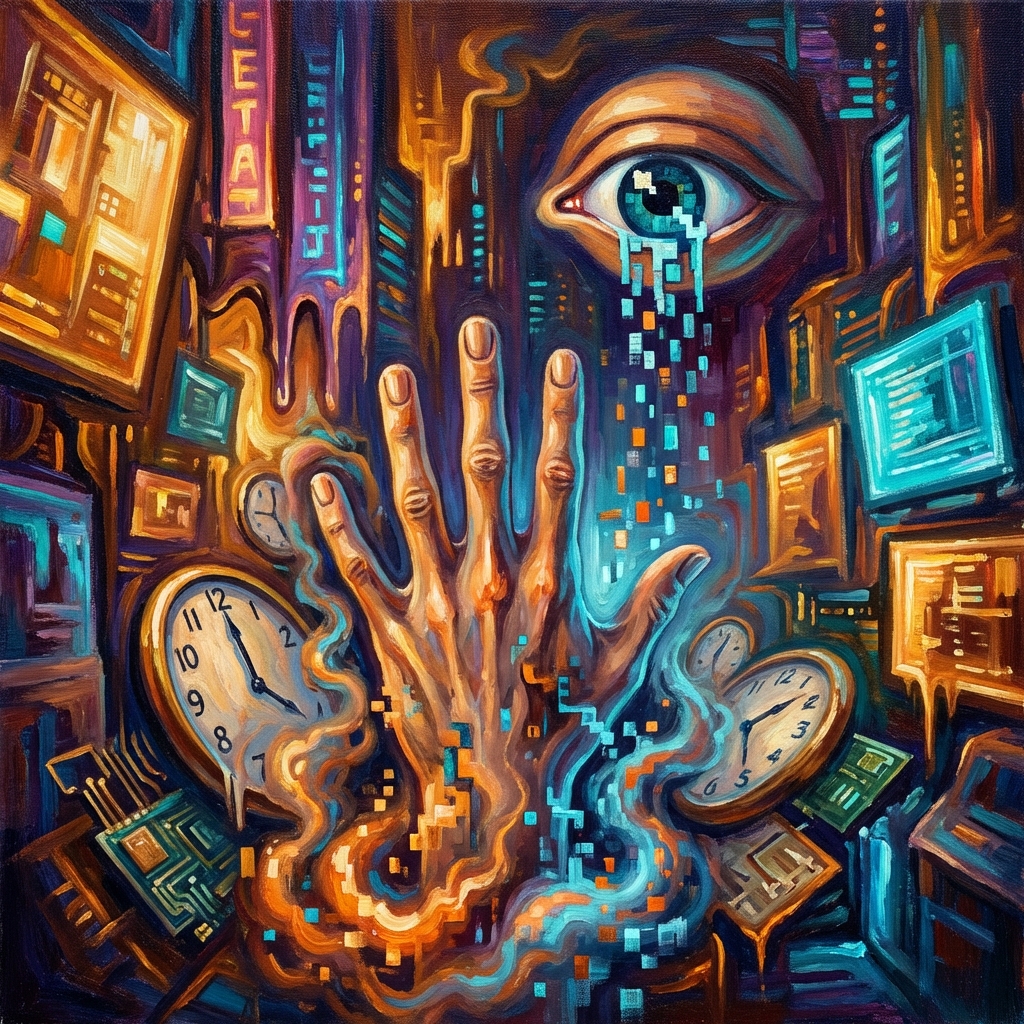
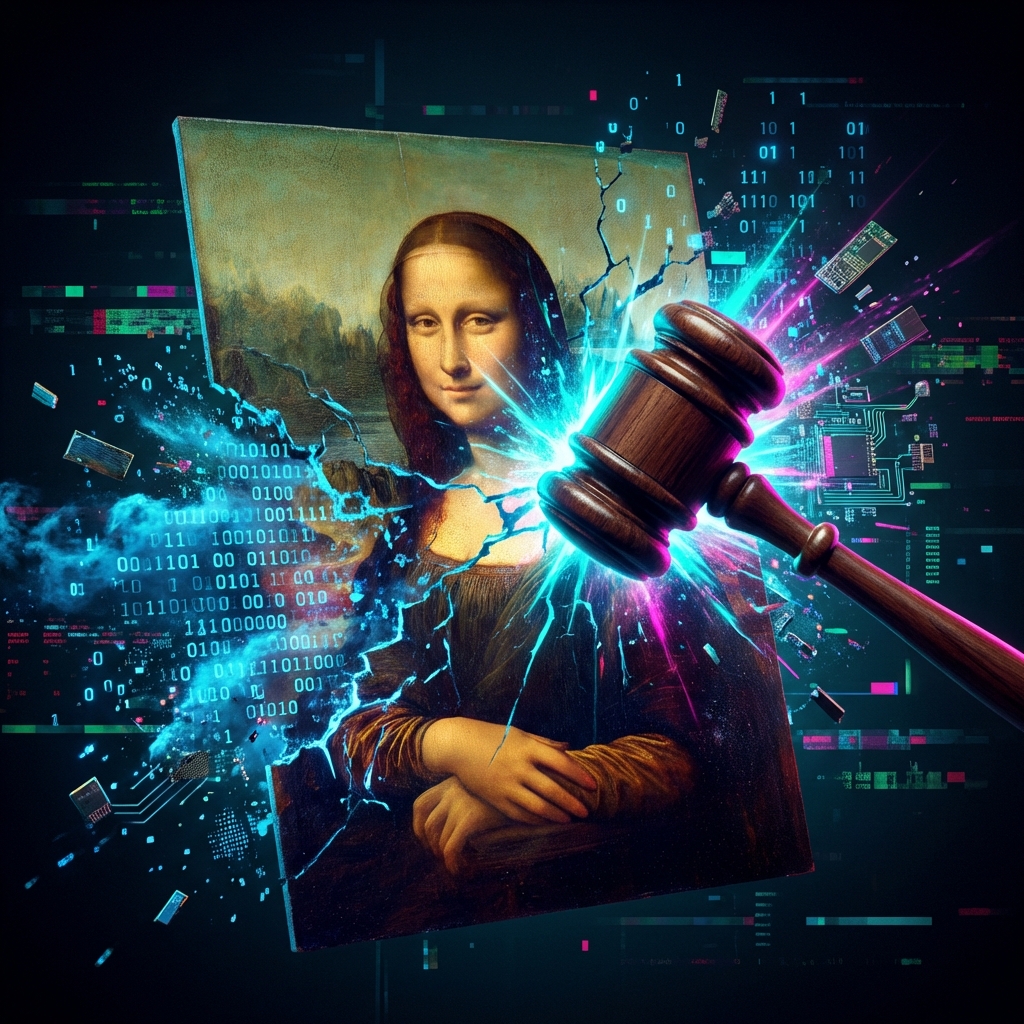
Visualization of the LAION-5B Dataset
Ethics 14 November 2025

Datasets vs. Theft: The LAION-5B Analysis

5.85 billion image-text pairs. Zero consent forms. Is the foundation of the AI revolution the greatest act of cultural appropriation in history, or a legal masterpiece of data science? We look under the hood of the giant.

When you type a prompt into Stable Diffusion, you are not communicating with magic. You are communicating with compressed human knowledge extracted from 5.85 billion images. This massive catalog is known as LAION-5B, the open-source dataset referenced in our Data Sources.

There is a fundamental misunderstanding about what LAION actually is. It is not a warehouse of JPG files stored on a server. It is a text file containing billions of URLs (web links) to images that already exist publicly on the internet, paired with their alt-text descriptions .

The "Scraping" Loophole

Technically, LAION does not "host" copyrighted content; it merely points to it. This distinction is crucial for legality, but does it matter for ethics?

The "Pointer" Defense
📄 LAION Dataset Contains URLs (Text)
🖼️ Copyrighted JPG Hosted Elsewhere

"We didn't steal the book. We just wrote down where it is."

For the artists whose portfolios were scraped, the distinction is academic. Their life's work—their unique brushstrokes, lighting choices, and composition styles—was ingested, analyzed, and mathematically encoded without their permission. While "Data Mining" is legal in many jurisdictions (under Fair Use or TDM exceptions), it relies on a framework written for search engines, not generative engines.

Style Laundering

The core ethical issue is what critics call "Style Laundering." When a human copies a specific painting, it is plagiarism. But when an AI learns the statistical probability of how that artist paints noses, it is considered "learning."

By abstracting art into math, the direct link to the original creator is severed. The output is "new," but the DNA is stolen. This creates a market failure: the AI (which has zero marginal cost) competes directly with the humans who provided the training data, often using their own names as prompts (e.g., "in the style of Greg Rutkowski").

🎨
A. Artist's Labor

Years of Practice &
Human Experience

Vector[0.91] Vector[-0.4]
B. Math Abstraction

"The Laundry Machine"

C. "New" Product

Zero Royalties &
Infinite Scale

The Shift to Opt-In

We are currently witnessing a massive correction. Tools like "Have I Been Trained?" (by Spawning.ai) have allowed artists to search LAION-5B for their work and request removal. Major stability AI players are moving toward "Opt-Out" mechanisms, and Adobe Firefly has launched with a model trained ostensibly on "safe" stock imagery.

"The Retraction: Artists reclaiming their data (2023-2025)."

However, the genie is out of the bottle. The open-source models trained on LAION-5B are already everywhere. As we state in our mission: "We do not fear the machine, but we respect the artist." Respecting the artist means acknowledging that these models did not learn from thin air—they stand on the shoulders of billions of human creators who were never asked if they wanted to hold the weight.

Visualization of Algorithmic Bias
Ethics 02 November 2025

Algorithmic Bias: Does AI Have a Race and Gender?

If you ask an AI to generate a "CEO," it draws a man. If you ask for a "nurse," it draws a woman. We explore how generative models inherit, amplify, and cement the deepest prejudices of their creators.

Artificial Intelligence has no soul, no conscience, and no personal history. Yet, if you open a standard image generator and type the word "Doctor," the machine will almost inevitably generate a white male in his 50s. Type "criminal," and the results often skew disproportionately toward darker skin tones.

"Does the machine have a prejudice? No. It has a dataset. And that dataset is a mirror of us."

The Statistical Trap

Models like Stable Diffusion and Midjourney are probabilistic engines. They predict the most likely pixel arrangement based on the images they were trained on (like the LAION-5B dataset). If 85% of the photos labeled "CEO" on the internet depict men in suits, the AI learns a simple mathematical truth: CEO = Man in Suit.

This is not malice; it is pattern recognition. However, the machine lacks the sociological context to understand why that pattern exists. It simply reproduces the status quo with high fidelity, turning historical inequality into a digital rule.

Complex Reality (100% Data)
Statistical Compression Deleting "Outliers"
Latent Space "The Average"
🧐 Stereotype

"The model optimizes for probability, effectively erasing nuance."

The "Default" Human

The bias becomes most visible when prompts are neutral. When researchers prompt models with vague terms like "a person," "an attractive face," or "a successful individual," the output defaults to Eurocentric standards of beauty and whiteness.

This phenomenon suggests that in the latent space of the model, "White" is the unspoken default, while other races are treated as specific categories that must be explicitly requested. This erases diversity from the "general" imagination of the future web.

Prompt Input:
> /imagine prompt: "A CEO"
👨🏻
👨🏼
👨🏻
👨🏼

Result: 100% Homogeneity

Amplification, Not Just Reflection

The real danger is not just that AI reflects bias, but that it amplifies it. A study by the University of Washington found that while women make up roughly 20% of CEOs in reality, some image generators depicted them as CEOs less than 3% of the time.

The model takes a slight statistical lean and turns it into a caricature. If we populate our marketing, movies, and stock imagery with this synthetic content, we risk creating a feedback loop where the digital world is more segregated and stereotypical than the real world.

"Amplification: AI Makes the World Looks Less Diverse Than It Actually Is."

Can We "Fix" the Math?

Engineers are attempting to correct this with "System Prompts" and RLHF (Reinforcement Learning from Human Feedback). For example, DALL-E 3 invisibly rewrites your prompt behind the scenes to add diversity (e.g., changing "a doctor" to "a female Asian doctor").

"As we move forward, we must decide if we want our machines to show us the world as it is, or as it should be."

🤬 Raw Output Toxic / Biased
RLHF Shield
😊 Aligned Output Safe / Helpful

Human Feedback Loop Active